Gauge
A YC-backed AI-visibility platform bundling brand-mention tracking with an AI content-creation engine, from $599/month.
Our verdict
Gauge is the only tool in this index that pairs AI-visibility monitoring with an actual AI content-creation engine, backed by named, sourced case studies (PostHog, Vellum AI) rather than vague percentage claims.
The only tool in this index bundling AI-visibility monitoring with its own AI content-creation engine — weigh that against having no plan priced below $599/month, and Claude/Grok coverage being Enterprise-only despite being listed among the platforms Gauge "monitors."
The CitedIndex digest
New tools, fresh verdicts, and who's earning the top spots. One short email.

What's great
- Bundles visibility monitoring with an AI content-creation engine that drafts 18 publish-ready articles a month (Growth) aimed at the specific gaps its tracking finds — most rivals in this index stop at measurement.
- Publishes named, sourced case studies with concrete numbers (PostHog: 41x LLM-referred traffic growth; Vellum AI: 1.4% to 40.3% visibility in 7 months) instead of only vague percentage claims.
- Y Combinator-backed (Summer 2024) with a named, six-person founding team and a verifiable public company profile — unusually transparent for a young tool in this index.
Watch-outs
- No tier below $599/month — Growth is the only self-serve plan, pricing above every other visibility-monitoring tool's cheapest paid tier in this index except Evertune's $800/month Pro plan.
- Claude and Grok coverage requires the custom-quoted Enterprise plan with API access — the $599/month Growth plan's engine list stops at ChatGPT, Google AI Overviews, Google AI Mode, Gemini, Perplexity and Microsoft Copilot.
- Effectively no independent third-party review history (G2, Capterra, TrustRadius) as of 2026-07 — a company founded in 2024 with no page yet on a major review platform, so its own case-study numbers can't be cross-checked against independent user reviews.
Also note: The Growth plan's 18-article/month content engine assumes a team with capacity to publish that volume — a lighter team may accumulate unused drafts rather than realize the visibility gains cited in Gauge's case studies.
How Gauge compares
The other tools buyers weigh against Gauge, and when to pick each.
| Tool | Best when you want… |
|---|---|
| GaugeThis page | Gauge is the only tool in this index that pairs AI-visibility monitoring with an actual AI content-creation engine, backed by named, sourced case studies (PostHog, Vellum AI) rather than vague percentage claims. |
| Otterly AI | The cheapest way to start if the content-creation engine isn't the point — $29/month versus Gauge's single $599/month Growth plan, though Otterly has no article-drafting engine and its default coverage is 4 engines versus Gauge's 6. |
| Writesonic | The direct fork on Gauge's own bundling pitch, far cheaper to start: an AI content engine plus visibility tracking from $79/month versus Gauge's $599/month floor, though Writesonic's Starter tracks only 3 engines versus Gauge's 6. |
| AthenaHQ | Covers Claude on its free Essential plan and adds Copilot/Grok on a $295/month self-serve Starter tier — both sit behind Gauge's custom-quoted Enterprise plan. Also Y Combinator-backed with its own conversational assistant (Ask Athena vs. Ask Gauge), but has no bundled content engine. |
What is Gauge?
Gauge is a Y Combinator-backed (Summer 2024) AI-visibility and generative engine optimization (GEO) platform built by Gauge Technologies, Inc. in San Francisco, founded by CEO Caelean Barnes and CTO Evan Doyle. It tracks how a brand is mentioned and cited across AI answer engines, then pairs that monitoring with an agentic content-creation engine that drafts AI-search-optimized articles aimed at closing the gaps its tracking finds. Where most tools in this category stop at measurement, Gauge bundles monitoring with the follow-through content work, priced as a single $599/month self-serve plan with no cheaper tier.
What does Gauge do?
Gauge runs a three-stage workflow: Track runs up to 600 prompts a day (Growth) against ChatGPT, Google AI Overviews, Google AI Mode, Gemini and Perplexity, logging roughly 108,000 AI answers a month for brand mentions, citation rate and sentiment. Understand layers competitor and content-gap analysis on top of the raw tracking data, showing which rivals get cited instead and why. Act closes the loop with a content-creation engine that drafts up to 18 publish-ready, AI-search-optimized articles a month (Growth), plus "Ask Gauge," a conversational agent for plain-language questions about the visibility data. Integrations with Google Analytics 4, Google Search Console and DataForSEO let Gauge correlate detected AI-answer citations against real referral traffic rather than reporting mention counts in isolation. Claude and Grok are covered only on the custom Enterprise plan and require API access; the self-serve Growth plan's six platforms stop at ChatGPT, Google AI Overviews, Google AI Mode, Gemini, Perplexity and Microsoft Copilot.
How Gauge works
- Track runs up to 600 prompts a day against ChatGPT, Google AI Overviews, Google AI Mode, Gemini and Perplexity, logging roughly 108,000 AI answers a month for brand mentions, citation rate and sentiment.
- Understand layers competitor and content-gap analysis on top of the raw tracking data, showing which rivals get cited instead and why.
- Act closes the loop with a content-creation engine that drafts up to 18 publish-ready, AI-search-optimized articles a month, plus 'Ask Gauge' for plain-language questions about the data.
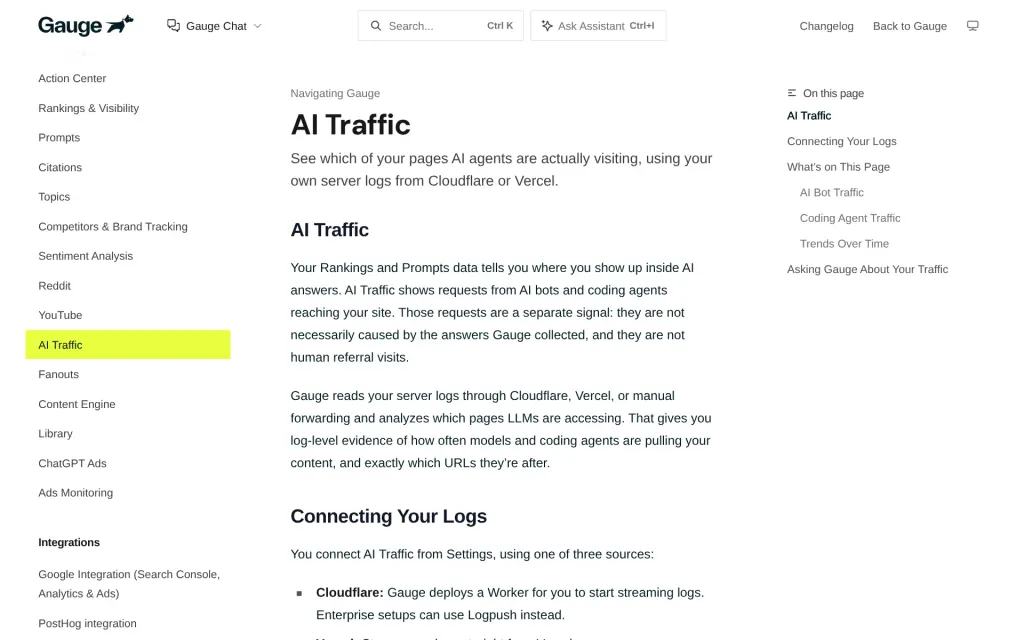
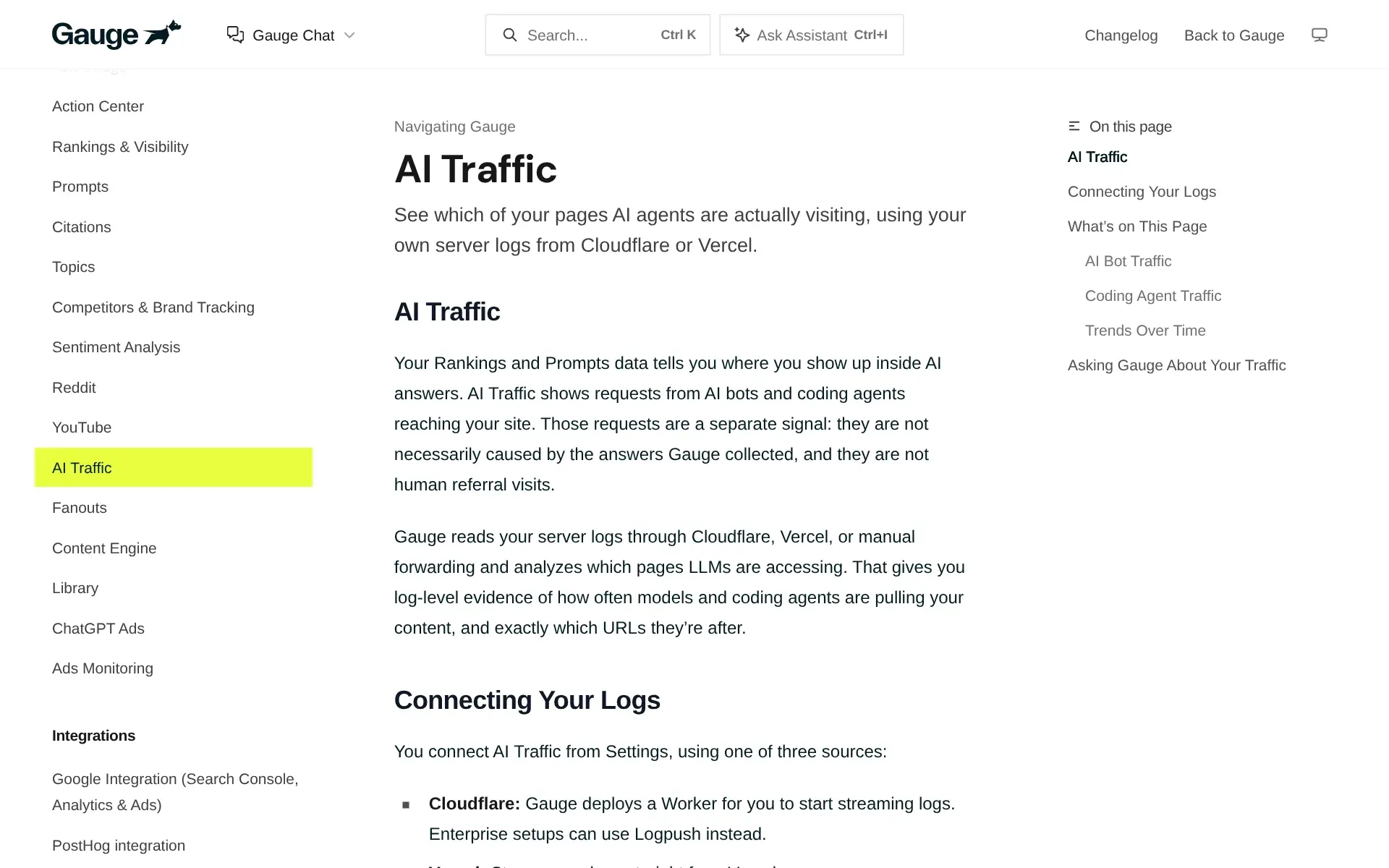
- Integrations with Google Analytics 4, Google Search Console and DataForSEO correlate detected AI-answer citations against real referral traffic, rather than reporting mention counts in isolation.
Who is Gauge for?
- Funded, content-capable marketing teams (B2B SaaS, dev tools) that want AI-visibility monitoring bundled with an AI content-creation engine rather than a bare scorecard.
- Marketing teams that need to prove AI-search ROI to leadership using GA4/Search Console-correlated referral traffic, not just a raw mention count.
- Teams that find a competitor being cited instead of them on a key prompt and want gap analysis plus an article engine to close it, not just a report flagging the gap.
Key features
- Daily multi-platform prompt tracking: Runs up to 600 prompts a day (Growth) across 6 AI platforms, tracking roughly 108,000 AI answers a month for brand mentions and citations.
- Competitor & content-gap analysis: Surfaces which competitors get cited instead of the brand and what content gap explains it.
- AI content-creation engine: Drafts up to 18 publish-ready, AI-search-optimized articles a month (Growth) targeted at the specific gaps Gauge's tracking finds.
- "Ask Gauge" agentic assistant: A conversational agent answering plain-language questions about the visibility data, included unlimited on Growth.
- Referral-traffic correlation: Connects GA4, Search Console and DataForSEO data to estimate how AI-answer citations translate into real referral traffic, not just mention counts.
What are Gauge's use cases?
- Proving AI-search ROI to leadership: A marketing team needs to show whether AI-citation work is translating into real traffic, using Gauge's GA4/GSC-correlated referral reporting rather than a raw mention count.
- Closing a specific citation gap with content: A team finds a named competitor is cited instead of them on a key prompt and uses Gauge's gap analysis plus its article engine to draft targeted content rather than only tracking the gap.
- A funded, multi-brand marketing team: Growth's 10 seats and unlimited tracked domains/competitors fit a team monitoring several properties, not a solo consultant on a tight budget.
What does Gauge integrate with?
- ChatGPT
- Google AI Overviews
- Google AI Mode
- Gemini
- Perplexity
- Microsoft Copilot
Why use Gauge?
- Bundles AI-visibility monitoring with an actual content-creation engine (18 AI-drafted, publish-ready articles a month on Growth) — most trackers in this index stop at measurement and leave content production to the buyer.
- Publishes named, sourced case studies with concrete before/after numbers (PostHog's 41x LLM-referred traffic growth; Vellum AI's climb from 1.4% to 40.3% visibility in seven months) rather than only unverifiable percentage claims.
- Correlates AI-citation activity against real GA4/Search Console referral traffic — one of the few tools in this index that ties visibility directly to a measurable traffic outcome.
- Y Combinator-backed (Summer 2024) with a named, six-person founding team and a verifiable public company profile, not an anonymous or agency-fronted product.
Pros & cons
Pros
- Bundles visibility monitoring with an AI content-creation engine that drafts 18 publish-ready articles a month (Growth) aimed at the specific gaps its tracking finds — most rivals in this index stop at measurement.
- Publishes named, sourced case studies with concrete numbers (PostHog: 41x LLM-referred traffic growth; Vellum AI: 1.4% to 40.3% visibility in 7 months) instead of only vague percentage claims.
- Y Combinator-backed (Summer 2024) with a named, six-person founding team and a verifiable public company profile — unusually transparent for a young tool in this index.
Cons
- No tier below $599/month — Growth is the only self-serve plan, pricing above every other visibility-monitoring tool's cheapest paid tier in this index except Evertune's $800/month Pro plan.
- Claude and Grok coverage requires the custom-quoted Enterprise plan with API access — the $599/month Growth plan's engine list stops at ChatGPT, Google AI Overviews, Google AI Mode, Gemini, Perplexity and Microsoft Copilot.
- Effectively no independent third-party review history (G2, Capterra, TrustRadius) as of 2026-07 — a company founded in 2024 with no page yet on a major review platform, so its own case-study numbers can't be cross-checked against independent user reviews.
Limitations
- The Growth plan's 18-article/month content engine assumes a team with capacity to publish that volume — a lighter team may accumulate unused drafts rather than realize the visibility gains cited in Gauge's case studies.
Gauge pricing
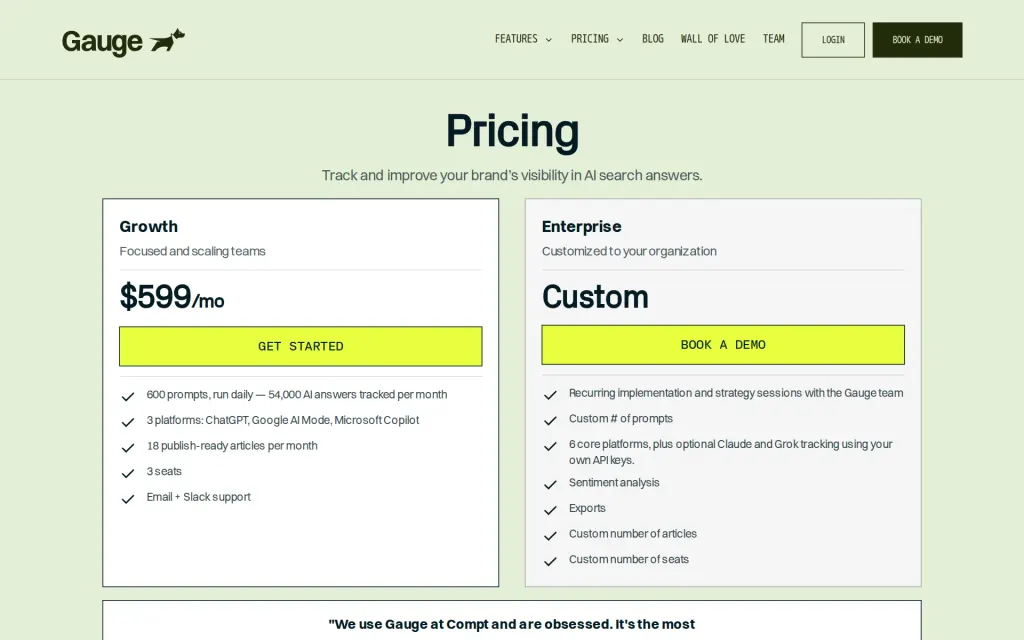
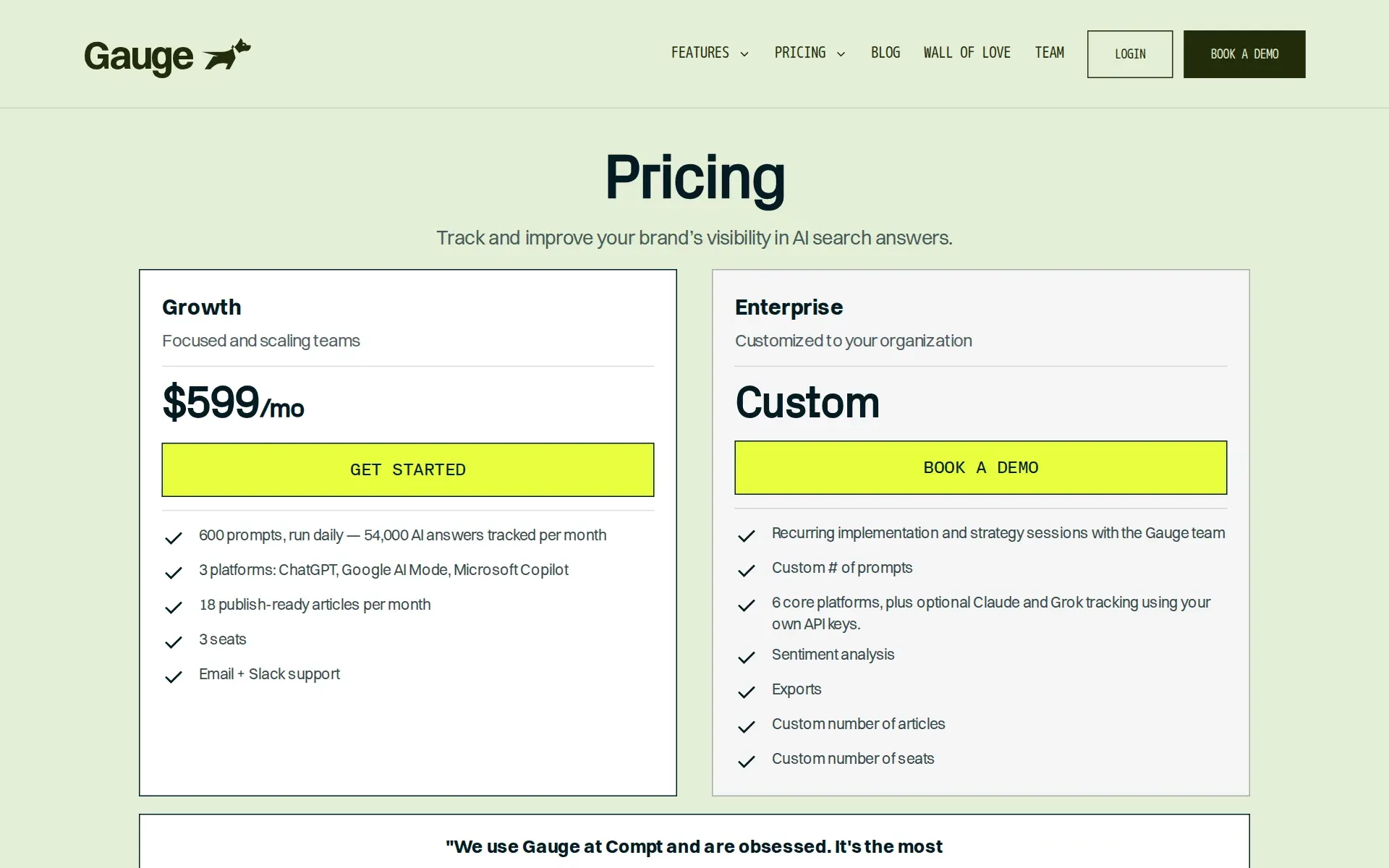
One named self-serve plan, Growth, at $599/month (600 daily prompts across 6 AI platforms, 18 AI-written articles, 10 seats, 1-week free trial); broader coverage (Claude, Grok, unlimited seats/articles) requires a custom-quoted Enterprise plan — there is no tier priced below $599/month.
- Growth$599 / month (1-week free trial)
- EnterpriseCustom
See current pricing on withgauge.com ↗Compare Gauge alternatives →
Gauge specs
Pricing
- Pricing model
- subscription
- Free tier
- ✗ No
Gauge review
Gauge is the only tool in this index that pairs AI-visibility monitoring with an actual AI content-creation engine, backed by named, sourced case studies (PostHog, Vellum AI) rather than vague percentage claims. But there's no entry tier: Growth starts at $599/month with no cheaper self-serve option, Claude and Grok require a custom Enterprise plan despite being listed among the engines Gauge "monitors," and as a 2024, YC-backed company it has essentially no independent review history yet. A strong pick for a funded marketing team that wants monitoring and content production in one tool and can act on 18 articles a month; a poor fit for a budget-constrained team or one that just wants a scorecard.
The only tool in this index bundling AI-visibility monitoring with its own AI content-creation engine — weigh that against having no plan priced below $599/month, and Claude/Grok coverage being Enterprise-only despite being listed among the platforms Gauge "monitors."
Frequently asked questions
How much does Gauge cost?
Which AI platforms does Gauge track?
Does Gauge just monitor visibility, or does it help fix gaps too?
Is Gauge an established company?
Gauge alternatives
- Otterly AI
The cheapest way to start if the content-creation engine isn't the point — $29/month versus Gauge's single $599/month Growth plan, though Otterly has no article-drafting engine and its default coverage is 4 engines versus Gauge's 6.
- Writesonic
The direct fork on Gauge's own bundling pitch, far cheaper to start: an AI content engine plus visibility tracking from $79/month versus Gauge's $599/month floor, though Writesonic's Starter tracks only 3 engines versus Gauge's 6.
- AthenaHQ
Covers Claude on its free Essential plan and adds Copilot/Grok on a $295/month self-serve Starter tier — both sit behind Gauge's custom-quoted Enterprise plan. Also Y Combinator-backed with its own conversational assistant (Ask Athena vs. Ask Gauge), but has no bundled content engine.
- Profound
Enterprise-scale pure measurement without the content-engine markup — Growth ($399/month, 3 engines) still undercuts Gauge's flat $599/month floor, and Enterprise adds SSO/SAML and SOC 2, though no tier drafts content or correlates GA4/Search Console referral traffic the way Gauge does.
Get a quote from Gauge
Tell us what you need. We make the introduction to Gauge.