RankLens
SEO Vendor's multi-sampling AI-visibility tracker for ChatGPT, Perplexity, Gemini, Claude, Grok, DeepSeek and Llama, free, with a DOI-registered methodology paper.
Best forbrands and agencies
Our verdict
RankLens is the most methodologically transparent free entry in AI-visibility tracking, its DOI-registered validation study and open-sourced probing code are a genuine differentiator, and tracking eight named engines through a free API beats most competitors' paywalled, 3-4-engine coverage.
Listed for a rare, real methodology paper (DOI + open-source code) in a category full of unverifiable “proprietary AI” claims, flagged for an unusually long, still-open Beta with zero independent reviews to date.
The CitedIndex digest
New tools, fresh verdicts, and who's earning the top spots. One short email.

What's great
- Publishes a real, DOI-registered validation study (52 categories x 4 locales, 15,600 prompt iterations, split-half stability of 1.00 at the top-3 level) and open-sources its entity-probe code, a level of methodological transparency almost no AI-visibility competitor in this directory offers.
- Tracks the widest named engine list in this category, ChatGPT, SearchGPT, Perplexity, Gemini, Claude, Grok, DeepSeek and Llama, versus the 3-4 engines most rivals cover.
- Ships a documented REST API with a free API key rather than gating programmatic access behind a paid or enterprise tier.
- Backed by an established company, SEO Vendor, founded 2005, a Google & Facebook Marketing Partner with a 55+ person team, rather than a single-founder side project.
Watch-outs
- No independent reviews found anywhere: ToolPilot's own listing shows 0 ratings and 0 reviews, and the product's Show HN launch post drew just 1 point and zero comments.
- The open-source “RankLens Entities” repo backing its methodology claim has only 2 GitHub stars, 0 forks, and no commits since October 2025, thin community engagement despite the open-source framing.
- About 20 months after its November 2024 launch, RankLens still has no published paid tier, everything, including “PRO” mode, remains free “during Beta” with no stated timeline for paid pricing, making long-term cost unpredictable.
- The name is not unique: an unrelated, unaffiliated free SEO-audit tool also called “RankLens” (hosted on the Lovable app-builder platform, a different domain) exists, worth confirming you're on SEO Vendor's seovendor.co product before signing up.
Also note: No visible SLA, uptime, or data-retention policy on the public marketing pages. · Public leaderboard pages are dated by month (e.g. “July, 2026”), so the product is built around periodic runs rather than real-time monitoring.
How RankLens compares
The other tools buyers weigh against RankLens, and when to pick each.
| Tool | Best when you want… |
|---|---|
| RankLensThis page | brands and agencies |
| Otterly AI | A far simpler, paid-from-day-one self-serve tool if you'd rather pay a known price than rely on an open-ended Beta. |
| Peec AI | One of the more established names in this category, with more third-party review coverage than RankLens currently has. |
| AIclicks | Broader paid-tier feature set with published pricing, if you want a committed roadmap instead of open-ended Beta pricing. |
What is RankLens?
RankLens is an AI-visibility tracking platform from SEO Vendor, a Henderson, Nevada-based marketing-technology company founded in 2005, that measures how often ChatGPT, SearchGPT, Perplexity, Gemini, Anthropic's Claude, Grok, DeepSeek and Llama mention and recommend a brand. Instead of scraping search results, it re-runs the same entity-conditioned prompt against each model 6 to 500 times, its patent-pending “MGPT” multi-sampling method, and aggregates the answers into a Visibility Index, a competitive Share-of-Voice score, and an LLM-confidence rating. Launched in November 2024 and still labeled “Beta,” RankLens backs its scoring with a DOI-registered, open-source-code research paper, a level of published methodology rare among AI-visibility trackers.
What does RankLens do?
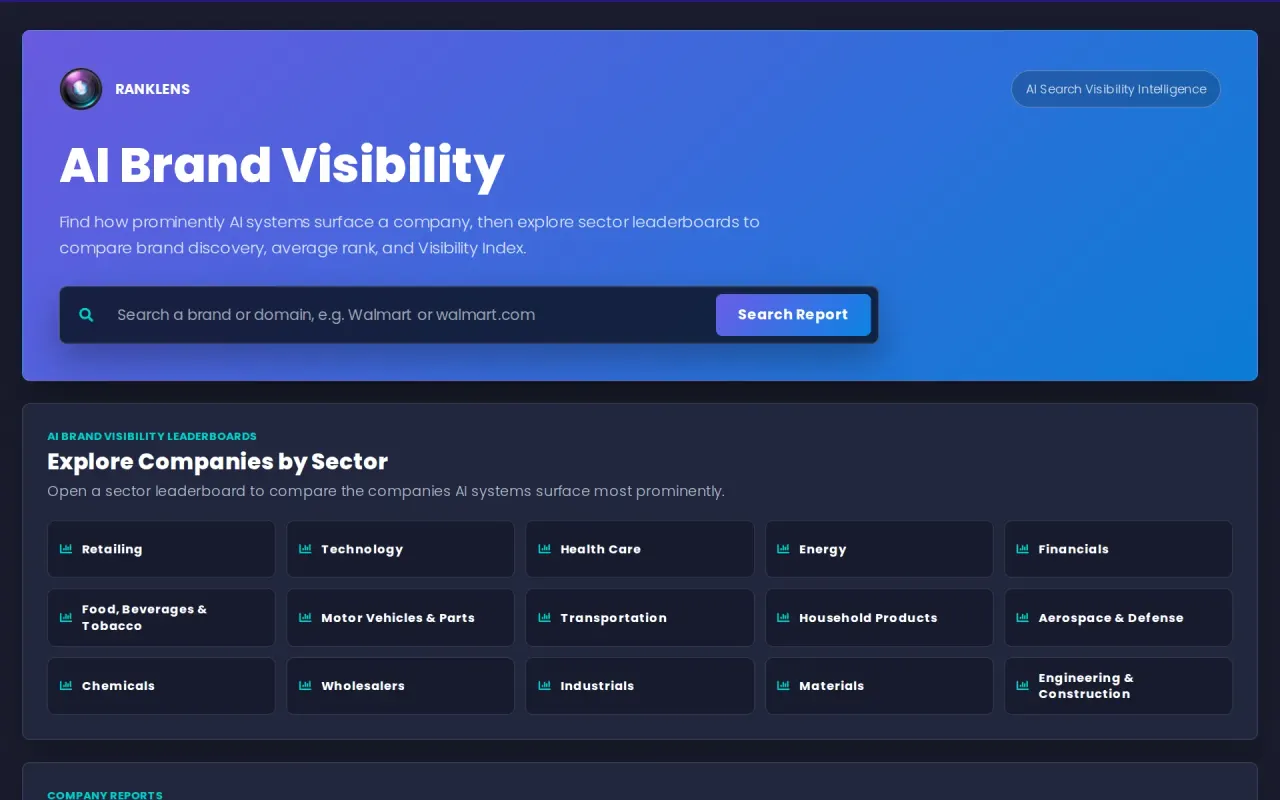
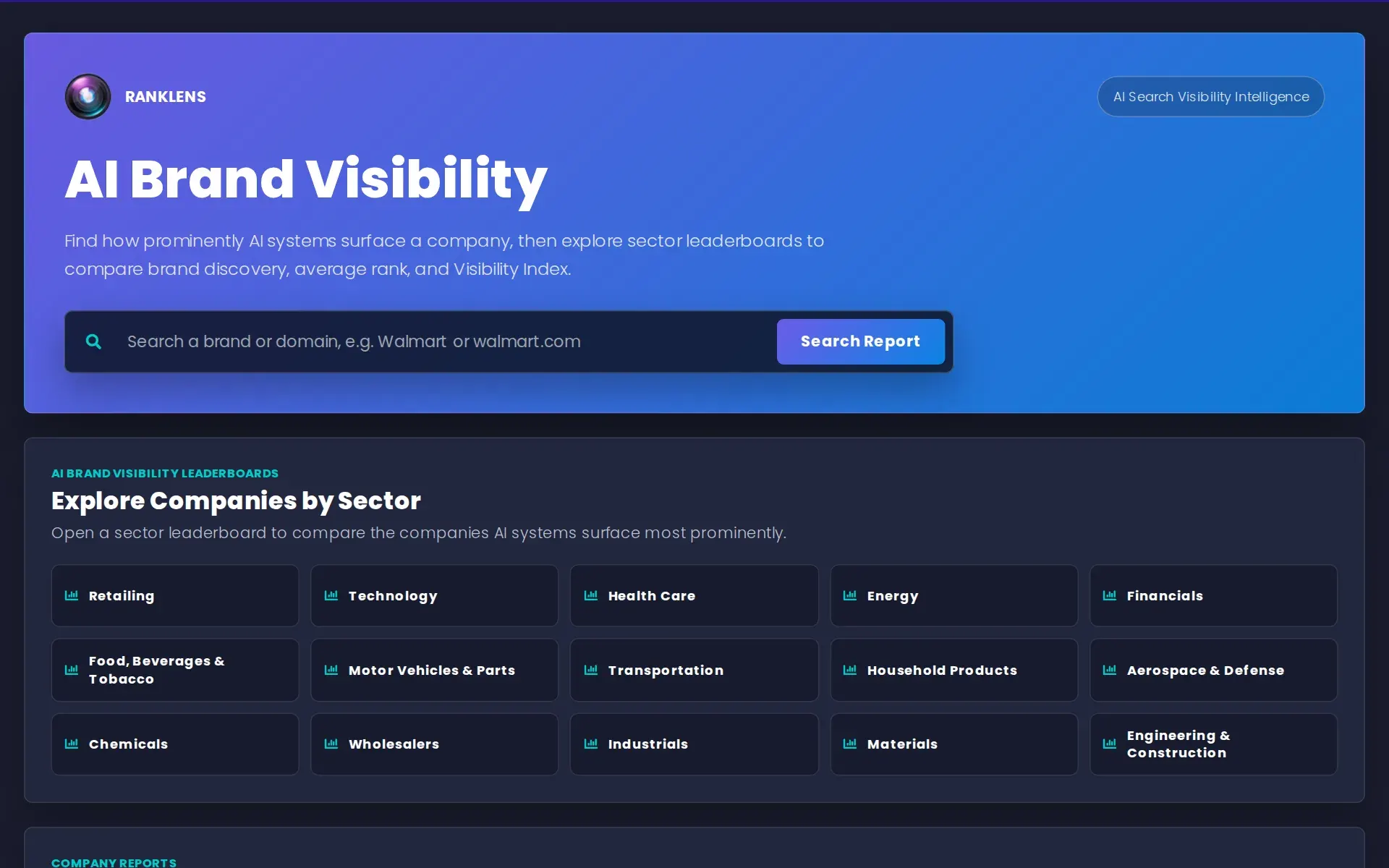
A user signs up for a free RankLens account, adds a brand or website entity, and defines the queries or topics to probe, RankLens calls these entity-conditioned probes. For each probe, the platform fires the same structured prompt at the selected AI engines between 6 and 500 times per run (its MGPT multi-sampling technique), rather than trusting a single, noisy response. The results roll up into five metrics per engine: Brand Match (exact brand/site mentions), Brand Target (precision when recommended), Brand Discovery / Share of Voice (how often it beats named competitors in “best X” style answers), LLM Confidence (how strongly the model backs the recommendation), and an aggregate Visibility Index. A public leaderboard (ranklens.seovendor.co) already runs the same methodology against large public companies by sector, letting a prospective user see the scoring in action before signing up. RankLens also ships a documented REST API (ai.seovendor.co/api/ranklens/), authenticated with a free API key, so the same metrics can be pulled into an existing reporting stack rather than read only from the dashboard. The underlying entity-probe framework and its validation study are both published: the probing code is open-sourced on GitHub, and a DOI-registered paper reports split-half stability testing across 52 product categories and 4 locales.
How RankLens works
- Sign up for a free account, add a brand or website entity, and define the queries or topics to probe — RankLens calls these entity-conditioned probes.
- For each probe, RankLens fires the same structured prompt at ChatGPT, SearchGPT, Perplexity, Gemini, Claude, Grok, DeepSeek and Llama between 6 and 500 times per run (its patent-pending MGPT multi-sampling method), rather than trusting one noisy response.
- Results roll up into five metrics per engine: Brand Match, Brand Target, Brand Discovery/Share of Voice, LLM Confidence and an aggregate Visibility Index.
- Pull the same metrics into an existing reporting stack via the free, documented REST API, authenticated with a free API key, instead of reading only from the dashboard.
Who is RankLens for?
- Brands and agencies that want free, broad-engine AI-visibility tracking with programmatic API access and are comfortable relying on a still-beta, not-yet-independently-reviewed product.
- Teams that weigh methodology transparency heavily — RankLens is one of the only tools in this category backed by a DOI-registered, open-source-code validation study rather than an unverifiable 'proprietary AI' claim.
- Developers who want to pull Visibility Index and Brand Match scores programmatically via a free, documented REST API rather than reading a dashboard by hand.
Key features
- Multi-sampling scoring (MGPT): Fires each entity-probe 6x to 500x per run to smooth out single-response noise, patent-pending.
- Five-metric scorecard: Brand Match, Brand Target, Brand Discovery/Share of Voice, LLM Confidence and an aggregate Visibility Index per engine.
- Public sector leaderboards: Live, dated AI-visibility rankings for large public companies by sector, viewable before signing up.
- Free documented REST API: JSON POST endpoints at ai.seovendor.co/api/ranklens/, authenticated with a free API key.
- Published, open-source methodology: Entity-probe code on GitHub plus a DOI-registered validation paper (52 categories x 4 locales, 15,600 prompt iterations).
What are RankLens's use cases?
- First AI-visibility baseline: A marketing team creates a free account, adds its brand as an entity, and runs an initial probe to see whether ChatGPT and Perplexity mention it at all versus named competitors.
- Competitive share-of-voice tracking: An agency benchmarks a client's brand against 2-3 named rivals across ChatGPT, Gemini and Claude to see which engine most favors a competitor.
- Programmatic reporting: A developer pulls Visibility Index and Brand Match scores via the free RankLens API into an existing client-reporting dashboard instead of checking the web UI by hand.
Why use RankLens?
- A DOI-registered, open-source-code validation study (52 categories x 4 locales, 15,600 prompt iterations) backs the scoring methodology, most AI-visibility tools publish no methodology paper at all.
- Tracks eight named AI engines (ChatGPT, SearchGPT, Perplexity, Gemini, Claude, Grok, DeepSeek, Llama), a broader list than most rivals in this category.
- A free, documented REST API ships without a paid-tier gate.
- Built by an established, 20-year-old, Google/Facebook Partner-certified marketing company rather than an unproven single-founder launch.
Pros & cons
Pros
- Publishes a real, DOI-registered validation study (52 categories x 4 locales, 15,600 prompt iterations, split-half stability of 1.00 at the top-3 level) and open-sources its entity-probe code, a level of methodological transparency almost no AI-visibility competitor in this directory offers.
- Tracks the widest named engine list in this category, ChatGPT, SearchGPT, Perplexity, Gemini, Claude, Grok, DeepSeek and Llama, versus the 3-4 engines most rivals cover.
- Ships a documented REST API with a free API key rather than gating programmatic access behind a paid or enterprise tier.
- Backed by an established company, SEO Vendor, founded 2005, a Google & Facebook Marketing Partner with a 55+ person team, rather than a single-founder side project.
Cons
- No independent reviews found anywhere: ToolPilot's own listing shows 0 ratings and 0 reviews, and the product's Show HN launch post drew just 1 point and zero comments.
- The open-source “RankLens Entities” repo backing its methodology claim has only 2 GitHub stars, 0 forks, and no commits since October 2025, thin community engagement despite the open-source framing.
- About 20 months after its November 2024 launch, RankLens still has no published paid tier, everything, including “PRO” mode, remains free “during Beta” with no stated timeline for paid pricing, making long-term cost unpredictable.
- The name is not unique: an unrelated, unaffiliated free SEO-audit tool also called “RankLens” (hosted on the Lovable app-builder platform, a different domain) exists, worth confirming you're on SEO Vendor's seovendor.co product before signing up.
Limitations
- No visible SLA, uptime, or data-retention policy on the public marketing pages.
- Public leaderboard pages are dated by month (e.g. “July, 2026”), so the product is built around periodic runs rather than real-time monitoring.
RankLens pricing
- FreeFree / no card required
- PRO (Beta)Free / during Beta
See current pricing on ranklens.seovendor.co ↗Compare RankLens alternatives →
RankLens specs
Pricing
- Pricing model
- free
- Free tier
- ✓ Yes
RankLens review
RankLens is the most methodologically transparent free entry in AI-visibility tracking, its DOI-registered validation study and open-sourced probing code are a genuine differentiator, and tracking eight named engines through a free API beats most competitors' paywalled, 3-4-engine coverage. But “Beta” has now lasted about 20 months with no published pricing roadmap, there isn't a single independent review or rating anywhere, including on RankLens' own ToolPilot listing, and its open-source repo has seen no real community pickup. It's a reasonable free first look at AI visibility for a team that wants broad engine coverage and API access without paying, but buyers who need a vendor with a proven track record, or who want confidence the product won't suddenly start charging, should treat it as a beta tool rather than a stable platform, and double-check they haven't landed on the unrelated, same-named SEO-audit tool on Lovable.
Listed for a rare, real methodology paper (DOI + open-source code) in a category full of unverifiable “proprietary AI” claims, flagged for an unusually long, still-open Beta with zero independent reviews to date.
Frequently asked questions
How much does RankLens cost?
Which AI engines does RankLens track?
Does RankLens have an API?
Is RankLens the same as the “RankLens” SEO audit tool on Lovable?
Who built RankLens, and is it independently reviewed?
RankLens alternatives
- Otterly AI
A far simpler, paid-from-day-one self-serve tool if you'd rather pay a known price than rely on an open-ended Beta.
- Peec AI
One of the more established names in this category, with more third-party review coverage than RankLens currently has.
- AIclicks
Broader paid-tier feature set with published pricing, if you want a committed roadmap instead of open-ended Beta pricing.
- AthenaHQ
YC-backed with nine-engine coverage — a pick with more independent validation than RankLens currently has.
- Profound
The enterprise-scale option if you outgrow a free, beta-labeled tool.
Get a quote from RankLens
Tell us what you need. We make the introduction to RankLens.