Vercel
Summary
Vercel is a cloud platform for frontend developers and product teams that want to build, deploy, and operate web applications with minimal configuration. It combines Automatic CI/CD, Preview Deployments, Global CDN, Fluid Compute, Observability, Web Application Firewall, and Web Analytics, plus a public API and Marketplace. It connects with GitHub, GitLab, Bitbucket, Slack, Datadog, New Relic, and OpenTelemetry, and counts Adobe, Stripe, Notion, Sonos, and Zapier among its customers. Plans run Free, Pro at $20/month, and Enterprise custom.
Verdict. Vercel centralizes deployment, preview review, observability, and edge delivery in one platform, with CI/CD, Preview Deployments, Global CDN, and Web Application Firewall available alongside a $20/month Pro tier and custom Enterprise pricing.
Reviewed byMathijs BronsdijkLast verifiedHow we evaluate
At a glance
- Vercel is best for frontend teams who need fast deployments and preview-based collaboration.
- Free; Pro $20/month; Enterprise custom
- 30 days, no credit card
- Yes — Public API for integrations and automations.
Highlights
- Preview Deployments make review and approval part of the deployment flow instead of a separate staging process.
- The platform combines hosting, CDN, compute, analytics, and security in one deployment surface.
- GitHub, GitLab, and Bitbucket support fits teams that already manage code in standard repositories.
- The public API and Marketplace make it easier to automate workflows and connect observability tools.
- Security features include DDoS mitigation and a Web Application Firewall for production apps.
What does Vercel do?
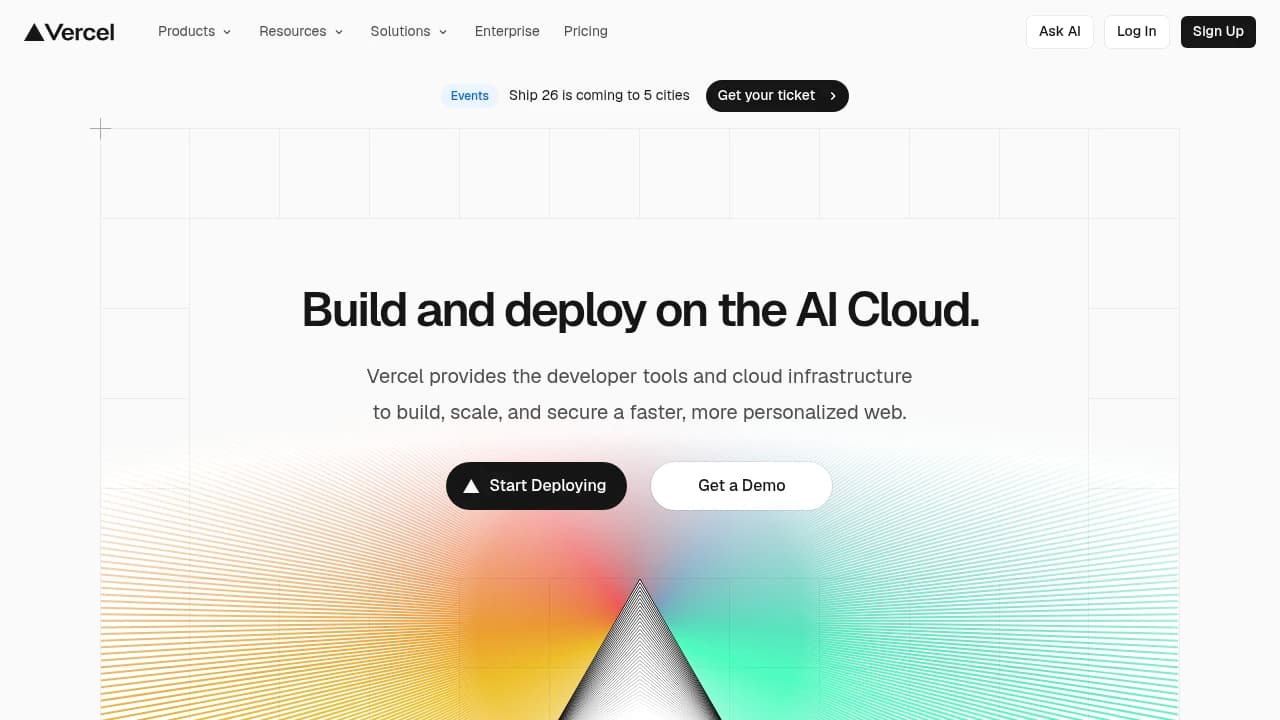
Vercel is a cloud platform for frontend developers and product teams that want to build, deploy, and operate web applications with minimal configuration. It is aimed at teams shipping modern apps across web and mobile surfaces, especially those that want faster releases, preview-driven collaboration, and managed infrastructure without heavy ops work. Its core platform includes Automatic CI/CD, Preview Deployments, Global CDN, Fluid Compute, Observability, Web Application Firewall, and Web Analytics. Customers include Adobe, Stripe, and Notion. The platform also offers a public API for integrations and automations, plus a Marketplace for extending workflows and connecting tools like GitHub, GitLab, Bitbucket, Slack, Datadog, New Relic, and OpenTelemetry.
Who is Vercel for?
- Frontend engineers who want minimal-config deployments for modern web apps.
- Platform engineers who need standardized CI/CD and governance across many projects.
- Product teams who want preview deployments for faster feedback and approvals.
- Security-conscious developers who need WAF, DDoS mitigation, and access controls.
What are Vercel's key features?
CI/CD
Automates builds and deployments from Git pushes or the CLI, helping teams ship faster without maintaining release pipelines.
Preview Deployments
Creates shareable previews for each push so reviewers can test changes before merge and catch UI or logic issues earlier.
Global CDN
Serves content through a worldwide edge network to reduce latency and keep pages fast for distributed users.
Fluid Compute
Runs serverless-style workloads with automatic scaling, giving apps compute capacity without managing servers directly.
Observability
Surfaces traces, logs, and traffic insights so teams can diagnose issues, monitor performance, and spot anomalies quickly.
Web Application Firewall
Adds granular protection against malicious traffic and common web attacks, supporting safer production deployments.
Marketplace
Extends Vercel with integrations and automations, including GitHub, GitLab, Bitbucket, Slack, Datadog, New Relic, and OpenTelemetry.
Web Analytics
Shows traffic and performance data inside the platform, helping teams understand usage patterns without adding a separate analytics stack.
How is Vercel used in practice?
Preview-driven product reviews
Product teams use Vercel to share Preview Deployments after every push, then collect feedback with built-in commenting before merging. That shortens review cycles and reduces the risk of shipping untested UI changes.
Frontend release automation
Frontend engineers use Vercel to connect GitHub, GitLab, or Bitbucket and trigger Automatic CI/CD from each commit. They get faster builds and no queues, which helps them ship changes without managing release infrastructure.
Secure app operations
Security-conscious developers use Vercel to deploy web apps behind the Web Application Firewall and Vercel Firewall, while monitoring Logs and Observability for anomalies. That helps them catch issues early and keep production traffic protected.
How does Vercel work?
- Connect your Git repository in the project dashboard, or deploy from the CLI, so Vercel can detect your app and start building it automatically.
- Choose the supported framework and let Automatic CI/CD handle builds, then use Zero-config deployment to avoid manual server setup.
- Push a change to create Preview Deployments for every branch, share the preview link, and gather feedback with built-in commenting before merging.
- Turn on Automatic HTTPS for every field, then watch Logs, Web Analytics, and Speed Insights to track traffic, performance, and deployment health.
- Use the Marketplace and public API to connect GitHub, Slack, Datadog, New Relic, or OpenTelemetry for alerts, automations, and deeper observability.
How much does Vercel cost?
Pro
$20/month- All core features
- Performance analytics
Enterprise
Custom- All Pro features
- Dedicated support
- Customization options
Frequently asked questions
What platforms does Vercel support?
Vercel supports web, iOS, Android, macOS, and Windows. That makes it usable for teams shipping across browser and native app surfaces, not just websites.
Is there a free plan?
Yes. Vercel offers a free plan, and its pricing page also describes a Hobby option as free forever for personal projects.
Does Vercel have an API?
Yes. Vercel provides a public API for integrations and automations, which is useful for connecting deployment workflows and operational tooling.
Can I connect Git providers?
Yes. Vercel supports GitHub, GitLab, and Bitbucket, and its homepage also shows importing a repo and deploying from Git.
What security features does Vercel offer?
Vercel offers DDoS protection and a Web Application Firewall. Those controls help protect deployed apps from common traffic-based attacks and malicious requests.
Which plan is right for my team?
The vendor says Hobby is for personal, non-commercial use, Pro is for professional developers, freelancers, and businesses, and Enterprise is for teams needing more performance, collaboration, and security.
Can Enterprise customers get custom invoicing?
Yes. Vercel says custom invoicing is available for Enterprise customers, which can help larger organizations align billing with procurement needs.
How does support work?
Vercel says users can reach support through the Help section on its website. It also states that Pro and Enterprise customers receive priority support, while free users rely on community resources.
What frameworks does Vercel support?
Vercel says it supports multiple frameworks, including Next.js and Nuxt, and its site also points to framework-specific documentation and templates.
How does Vercel monitor performance?
Vercel uses real-time infrastructure and traffic insights for monitoring, and its Observability product adds logs and tracing so teams can debug issues and tune performance.
Editor's read
Check whether your workflow depends on Marketplace integrations beyond GitHub, GitLab, Bitbucket, Slack, Datadog, New Relic, and OpenTelemetry. Also verify whether the Free tier is enough, since Pro adds advanced performance analytics and Enterprise is the only custom option.

Similar to Vercel
 Your brand here