Supabase
Summary
Supabase is an open-source Postgres development platform for developers and product teams that want to build application backends without stitching together separate services. Its stack includes Postgres Database, Authentication, Edge Functions, Storage, Realtime, Vector, Data APIs, and Row Level Security, plus role-based access control. Integrations include GitHub, Slack, Stripe, Discord, Zapier, Firebase, and Cloudflare. Named customers include Mozilla, GitHub, 1Password, PwC, eXp Realty, Gopuff, Chatbase, Twitch, and Discord. Pricing runs Free $0/month, Pro $25/month, Team $599/month, and Enterprise custom.
Verdict. Supabase centralizes Postgres Database, Authentication, Data APIs, Realtime, and Row Level Security in one platform, with Free at $0/month, Pro at $25/month, Team at $599/month, and Enterprise custom pricing for larger deployments.
Reviewed byMathijs BronsdijkLast verifiedHow we evaluate
At a glance
- Supabase is best for product teams who need a Postgres backend with auth, APIs, and realtime in one platform.
- Free $0/mo; Pro $25/mo; Team $599/mo; Enterprise custom
- Yes — Public RESTful API for accessing the Supabase features.
Highlights
- Open-source and self-hostable, so teams can keep control over infrastructure and data residency.
- Combines database, auth, APIs, storage, and realtime in one platform instead of separate vendors.
- Auto-generated APIs reduce backend boilerplate for teams building quickly on Postgres.
- Row Level Security gives fine-grained access control directly in the database layer.
- Supports enterprise needs with SOC 2, ISO 27001, HIPAA, and uptime SLAs.
What does Supabase do?
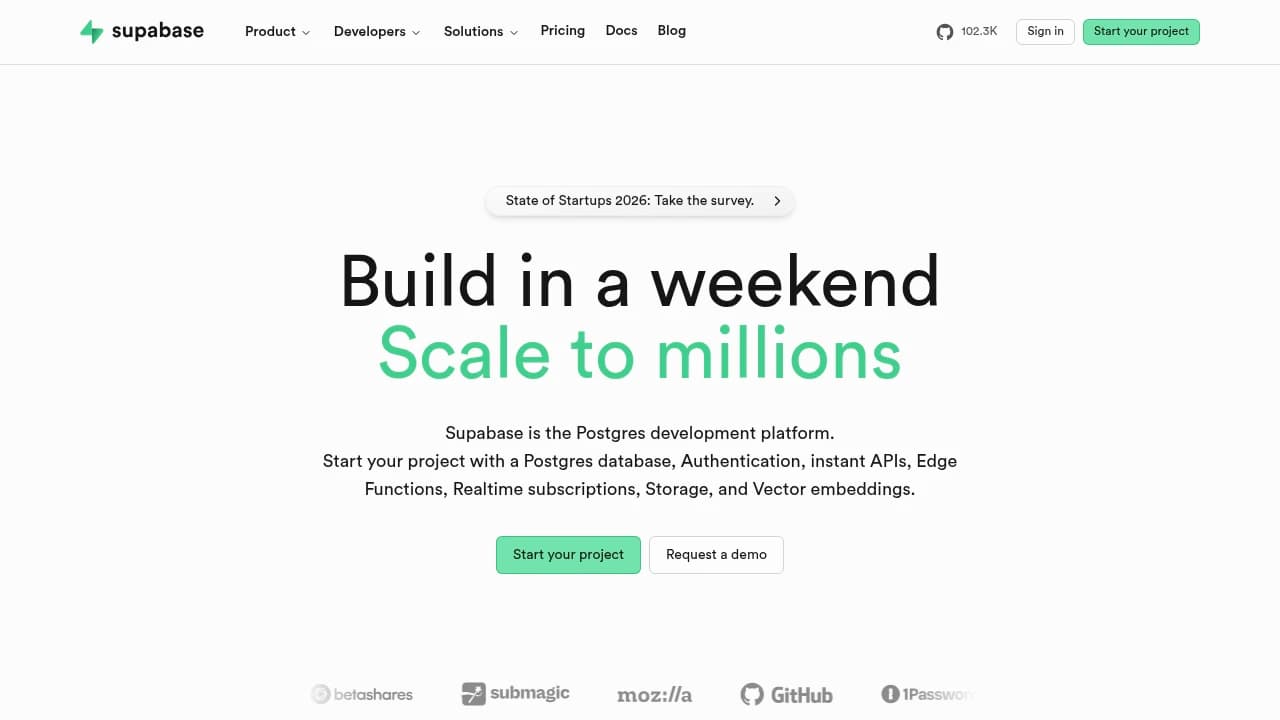
Supabase is an open-source Postgres development platform for developers and product teams that want to build application backends without stitching together separate database, auth, API, storage, and realtime services. It is aimed at startups, innovation teams, and enterprises that need to move from prototype to production while keeping control over data and infrastructure. Its core stack includes a Postgres database, Authentication, Edge Functions, Storage, Realtime subscriptions, Vector embeddings, and auto-generated APIs. Supabase also offers Row Level Security, role-based access control, and integrations such as GitHub, Slack, Stripe, Discord, Zapier, Firebase, and Cloudflare. The platform says it has 102.3K GitHub stars, 16,000,000+ databases created, 90,000+ databases launched daily, and serves users in 195 countries. Customers named on its site include Mozilla, GitHub, 1Password, PwC, and eXp Realty, and it can also be self-hosted.
Who is Supabase for?
- Startup engineers who need to ship a production backend quickly without assembling many services.
- Innovation teams who want non-technical builders to create apps on enterprise infrastructure.
- Backend developers who prefer Postgres, SQL, and fine-grained access control.
- Enterprise platform teams who need security reviews, compliance, and self-hosting options.
What are Supabase's key features?
Postgres Database
Run your app on managed Postgres, so teams can model relational data with SQL and keep a familiar database foundation.
Authentication
Add sign-up, sign-in, and user management flows without building them from scratch, which speeds up secure app launches.
Edge Functions
Run server-side logic close to your app, useful for custom workflows, webhooks, and backend tasks that should not live in the client.
Storage
Store and serve files alongside your database, keeping uploads, assets, and app data in one platform.
Realtime
Push live updates from the database to clients through realtime subscriptions, which helps dashboards, chats, and collaborative apps stay current.
Vector
Store and work with embeddings for AI features, including similarity search and retrieval workflows built on PostgreSQL.
Data APIs
Expose database data through RESTful and GraphQL APIs generated from your schema, reducing boilerplate for frontend and mobile apps.
Row Level Security
Control which rows each user can read or change with Postgres policies, a key safeguard for multi-tenant and regulated applications.
How is Supabase used in practice?
Startup backend launch
Startup engineers use Supabase to launch a new app backend fast, starting with the Postgres Database and Authentication. They add Edge Functions and Realtime subscriptions to support product logic and live updates without building separate services.
Enterprise AI prototypes
Innovation teams use Supabase to turn prototypes into production systems, using auto-generated APIs and Row Level Security to keep access controlled. The same backend can support internal builders while meeting enterprise security expectations.
Secure customer apps
Backend developers use Supabase to model data in Postgres Database, then expose it through Data APIs and Authentication services. Row Level Security helps them restrict records by user, which matters for multi-tenant SaaS and regulated workflows.
How does Supabase work?
- Start your project in Supabase, then create the first project and choose the workspace where your backend will live.
- Set up your Postgres Database by defining tables and relationships, then use PostgreSQL Compatibility to keep your schema familiar.
- Configure Authentication services and Role-Based Access Control so users sign in and only see the records they should access.
- Add Edge Functions and connect your frontend through Auto-generated APIs or REST APIs to handle app logic and data access.
- Organize files in Storage, enable Realtime subscriptions, and keep shipping with Daily backups as your app grows.
How much does Supabase cost?
Free
$0- Unlimited API requests
- 50,000 monthly active users
- 500 MB database size
- 5 GB egress
- 1 GB file storage
- Community support
Pro
$25- Everything in the Free Plan, plus
- 100,000 monthly active users
- 8 GB disk size per project
- 250 GB egress
- Email Support
- Daily backups stored for 7 days
Team
$599- Everything in the Pro Plan, plus
- SOC2 & ISO 27001
- Priority email support
- Daily backups stored for 14 days
Enterprise
Custom- Designated Support manager
- Uptime SLAs
- 24×7×365 support
Frequently asked questions
What is Supabase?
Supabase is an open-source Firebase alternative built around a Postgres database, authentication, instant APIs, and realtime capabilities. It is designed for teams that want a full backend platform without assembling those pieces separately.
Is there a free plan?
Yes. Supabase offers a Free plan at $0 per month with unlimited API requests, 50,000 monthly active users, 500 MB database size, 5 GB egress, 5 GB cached egress, 1 GB file storage, and community support.
Does Supabase have an API?
Yes. Supabase provides a public RESTful API for accessing its features, and its platform also includes auto-generated APIs from your database schema.
Can I self-host Supabase?
Yes. Supabase can be self-hosted, and the company describes itself as open source from day one so teams can read, contribute, and run it on their own infrastructure.
What security and compliance does it support?
Supabase says it is SOC 2 Type 2 certified, HIPAA compliant, and ISO 27001 certified. Its pricing tiers also mention SOC2 & ISO 27001 on Team, with HIPAA available as a paid add-on.
What support options are available?
Support starts with documentation, community forums, and Discord. Paid plans add email support, priority email support and SLAs on Team, and a designated support manager plus 24×7×365 premium support on Enterprise.
Can I cap my usage costs?
Yes. Supabase says the Pro plan has a spend cap enabled by default to help keep costs under control, and it also notifies users as they approach plan limits.
What integrations does Supabase support?
Supabase lists integrations such as GitHub, Discord, Twitter, YouTube, Stripe, Slack, Zapier, Firebase, and Cloudflare. Its integrations page also shows partner tools like Cloudflare Workers and Resend.
What happens if I cancel my subscription?
Cancellation stops services immediately, while any remaining billed period is still honored. That makes the billing behavior explicit if a team decides to leave.
Editor's read
Check the Team tier if SOC2 and ISO 27001 are required, since those controls appear there rather than on Free or Pro. Also verify whether your deployment needs self-hosting, which the platform supports but is a separate buyer-side decision.

Similar to Supabase
 Your brand here