Plausible
Summary
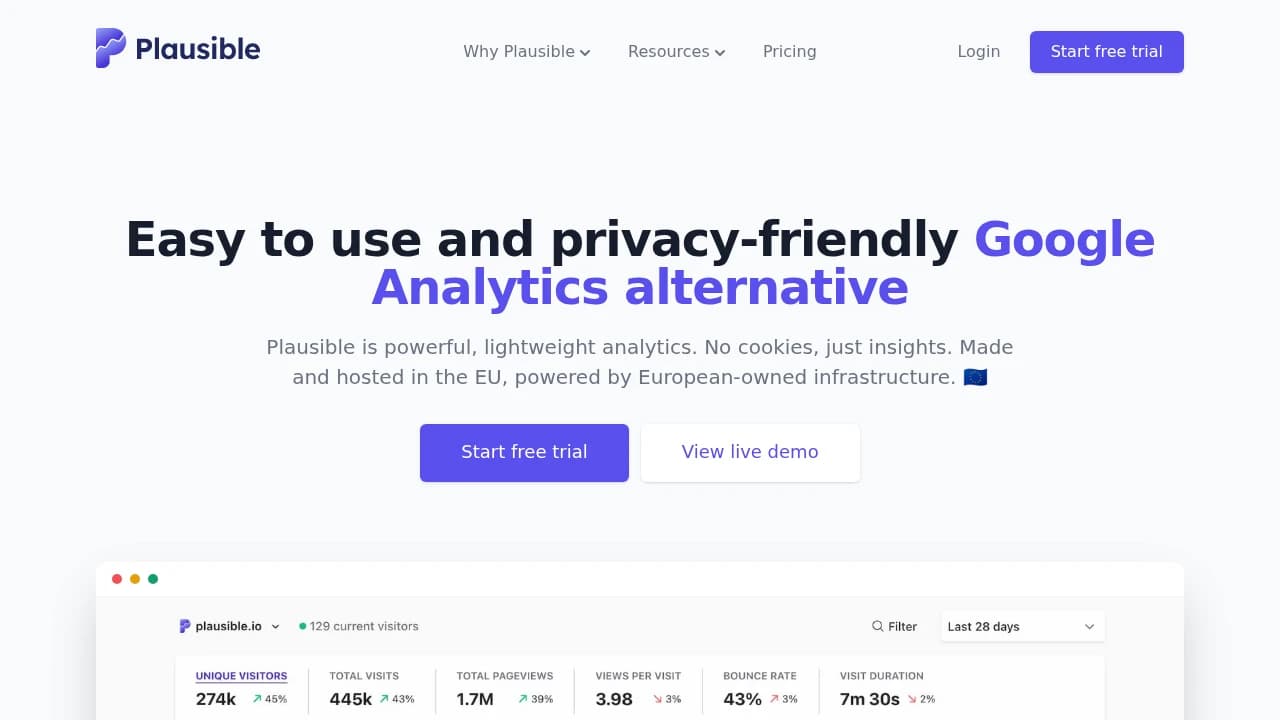
Plausible is a privacy-focused web analytics platform for website owners, startups, agencies, publishers, and enterprise teams that want clear traffic measurement without traditional analytics complexity. It combines a simple analytics dashboard, lightweight script, privacy-friendly analytics, open source code, and EU-hosted infrastructure, plus goals and custom events, scroll-depth tracking, visitor segmentation, email/Slack reports, Google Analytics import, and a public API. Customers include Hugging Face, Basecamp, MongoDB, Sentry, Vercel, and Harvard University. Plans run Starter $9/month, Growth $14/month, Business $19/month, and Enterprise custom.
Verdict. Plausible pairs a simple dashboard and lightweight script with privacy-friendly analytics, EU-hosted infrastructure, and reporting features like Shared Links and Embedded Dashboards, while pricing starts at $9/month and scales to custom Enterprise.
Reviewed byMathijs BronsdijkLast verifiedHow we evaluate
At a glance
- Plausible is best for privacy-conscious teams who want simple website analytics without cookie banners.
- Starter $9/month; Growth $14/month; Business $19/month; Enterprise custom
- 30 days, no credit card
- Yes — Plausible offers a public API for developers, with Stats API access on paid plans and Sites API access on Enterprise.
Highlights
- No cookies or personal-data tracking, which reduces consent-banner overhead for privacy-sensitive sites.
- Self-hosting is available for teams that want to run analytics on their own infrastructure.
- The dashboard stays intentionally simple, which lowers the learning curve for non-analysts.
- EU-hosted infrastructure helps organizations keep data within European-owned systems.
- The product includes practical reporting tools like Email/Slack reports, Shared Links, and Embedded Dashboards.
What does Plausible do?
Plausible is a privacy-focused web analytics platform for website owners, startups, agencies, publishers, and enterprise teams that want clear traffic measurement without the complexity of traditional analytics. It is a simpler alternative to Google Analytics, with no cookies, no personal-data tracking, and no consent banners required. The product centers on a simple analytics dashboard, a lightweight script, privacy-friendly analytics, open source code, and EU-hosted infrastructure. It supports goals and custom events, scroll-depth tracking, visitor segmentation, email/Slack reports, Google Analytics import, and a public API. Named customers include Hugging Face, Basecamp, MongoDB, Sentry, and Harvard University, and teams can self-host it on their own infrastructure if needed.
Who is Plausible for?
- Startup and SaaS teams who need straightforward traffic and conversion tracking without analytics training.
- Agencies who need client-ready reporting and shared dashboards across multiple sites.
- Publishers and creators who want lightweight measurement that does not slow pages down.
- Enterprise teams who need EU-hosted analytics with self-hosting and compliance controls.
What are Plausible's key features?
Simple analytics dashboard
Shows the important metrics on one page, so teams can read traffic and conversions without training or a complicated reporting setup.
Lightweight script
Loads fast and is designed not to hurt page speed or Core Web Vitals, which matters for sites that care about performance.
Privacy-friendly analytics
Tracks pageviews and custom events without cookies or personal data, reducing consent-banner friction and privacy-law headaches.
Open source
The code is public and auditable, and teams can self-host on their own infrastructure when they need more control.
EU-hosted
Runs on European-owned infrastructure in the EU, keeping data inside the EEA for organizations with residency requirements.
How is Plausible used in practice?
Startup traffic tracking
A startup SaaS team uses Plausible to monitor visits, conversions, and scroll depth from one dashboard, using Goals and custom events to see which pages drive signups without adding tag-manager complexity.
Agency client reporting
An agency uses Plausible to build client-facing reports and share them through Shared Links and Embedded Dashboards, turning site traffic into clear monthly updates without exporting spreadsheets.
Enterprise compliance analytics
An enterprise analytics team uses Plausible to measure website performance with the Stats API and EU-hosted infrastructure, keeping reporting aligned with privacy requirements while avoiding cookie banners.
How does Plausible work?
- Add the Plausible script to your website or install the WordPress plugin, then confirm the site appears in My dashboard.
- Open the simple analytics dashboard to start seeing visitors, page views, and conversion data on one page.
- Create Goals and custom events for signups, purchases, or scroll depth so the dashboard reflects the actions that matter.
- Use Email/Slack reports, Saved Segments, and Shared Links to distribute insights to teammates or clients.
- Connect the Stats API or Looker Studio Connector when you need custom reporting, blended dashboards, or scheduled exports.
How much does Plausible cost?
Starter
$9/month- One site
- 3 years of data retention
- Privacy-friendly dashboard
- Email/Slack reports
- Google Analytics import
- Goals and custom events
- Saved Segments
Growth
$14/month- Everything in Starter
- Up to 3 sites
- Team Management
- Shared Links
- Embedded Dashboards
- Shared Segments
Business
$19/month- Everything in Growth
- Up to 10 sites
- 5 years of data retention
- Custom Properties
- Stats API (600 requests per hour)
- Looker Studio Connector
- Ecommerce revenue attribution
- Funnels
- Consolidated View
Enterprise
Custom- Everything in Business
- 10+ sites
- 10+ team members
- 600+ Stats API requests per hour
- Sites API access
- Single Sign-On (SSO)
- Managed Proxy
- Scheduled raw event data exports
- 5+ years of data retention
- Priority support
Frequently asked questions
Does Plausible use cookies?
No. Plausible says it does not use cookies or track personal data, which is why it can avoid the usual cookie-banner workflow.
Can I self-host Plausible?
Yes. Plausible says you can self-host it on your own infrastructure, and its open-source code is public and auditable.
Is there a free trial?
Yes. Plausible offers a 30-day free trial, and the site says no credit card is required to start.
What API does Plausible offer?
Plausible offers a public API for developers. The paid plans also mention a Stats API, and Enterprise includes Sites API access for deeper integrations.
What integrations does Plausible support?
Plausible names WordPress, Google Tag Manager, Zapier, GitHub, and Looker Studio among its integrations and connectors.
Is Plausible open source?
Yes. Plausible says the code is open source and available for public scrutiny, which also supports self-hosting.
Where is Plausible hosted?
Plausible says it is built and hosted in the EU on European-owned infrastructure, and that customer data never leaves the EEA.
What kind of reporting does Plausible provide?
Plausible provides real-time report metrics such as visitors, page views, and conversion tracking, plus Email/Slack reports and shared dashboards on higher plans.
How does Plausible handle customer data?
Plausible says it does not sell or share customer data, and that data is processed in aggregate rather than as personal profiles.
Editor's read
Check the Stats API ceiling before committing: Business includes 600 requests per hour, while Enterprise raises that to 600+ and adds Sites API access. If your reporting stack depends on frequent pulls or API-driven dashboards, that tier jump matters.

Similar to Plausible
 Your brand here