Canonry
Free, self-hosted, agent-first AEO platform: tracks AI-engine citations and executes the fixes.
Best fordeveloper-led or privacy-conscious teams
Our verdict
The self-hosted, agent-native alternative to this category's paid SaaS dashboards, free and source-available, and the only tool here that closes the loop from audit to fix, but budget real setup time (your own API keys, a Node.js runtime) and note the license restricts building a competing hosted product on it for two years per release.
We ran Canonry's own technical-aeo audit live against a 5-page sample of citedindex.com's sitemap for this listing (aggregate score 66/100, strongest on AI-crawler access and schema validity, weakest on Citations & Authority Signals at 24/100 and E-E-A-T Signals at 28/100), confirming the audit works as documented rather than taking the README on faith. Company-background facts are limited to what Canonry states about itself (canonry.ai) plus independently verified GitHub/npm data; the founder's identity (Arber Xhindoli) was cross-checked via his own dev.to post and GitHub profile, not taken from the vendor site alone.
The CitedIndex digest
New tools, fresh verdicts, and who's earning the top spots. One short email.

What's great
- Free and source-available (FSL-1.1-ALv2, converts to Apache 2.0 two years after each release), the fullest-featured self-hosted alternative to this category's paid SaaS dashboards, with a real dashboard, CLI, API and MCP adapter, not just a script.
- Genuinely active: 92 GitHub stars, 12 forks, 690+ commits and a push earlier today, not an abandoned side project.
- Closes the loop other visibility-only tools in this index don't: technical-aeo audit -> JSON-LD/WordPress fix -> citation re-check, in one product.
Watch-outs
- Self-hosting requires your own AI-provider API keys and a Node.js >=22.14 runtime, real setup friction next to a hosted SaaS's zero-install signup.
- FSL-1.1-ALv2 is source-available, not OSI-approved open source: it restricts using Canonry itself to build a competing hosted AEO product until each version's two-year Apache-2.0 conversion date.
- The paid agency layer (Embedded, Ads, Managed) has no published pricing, the same opacity as this category's enterprise incumbents, despite the free self-hosted core.
Also note: No first-party hosted dashboard for solo users, the only managed/hosted option (Embedded/Managed) is scoped and custom-quoted for agencies, not individuals. · A young project (first commit 2026-03-09, about 4 months old at review) with far less track record than the venture-funded incumbents in this index.
How Canonry compares
The other tools buyers weigh against Canonry, and when to pick each.
| Tool | Best when you want… |
|---|---|
| CanonryThis page | developer-led or privacy-conscious teams |
| Trakkr | Trakkr is a paid, hosted SaaS with GA4 revenue attribution, named-competitor benchmarking and an AI agent that auto-applies weekly actions, if you want a no-install tool over self-hosted software. |
What is Canonry?
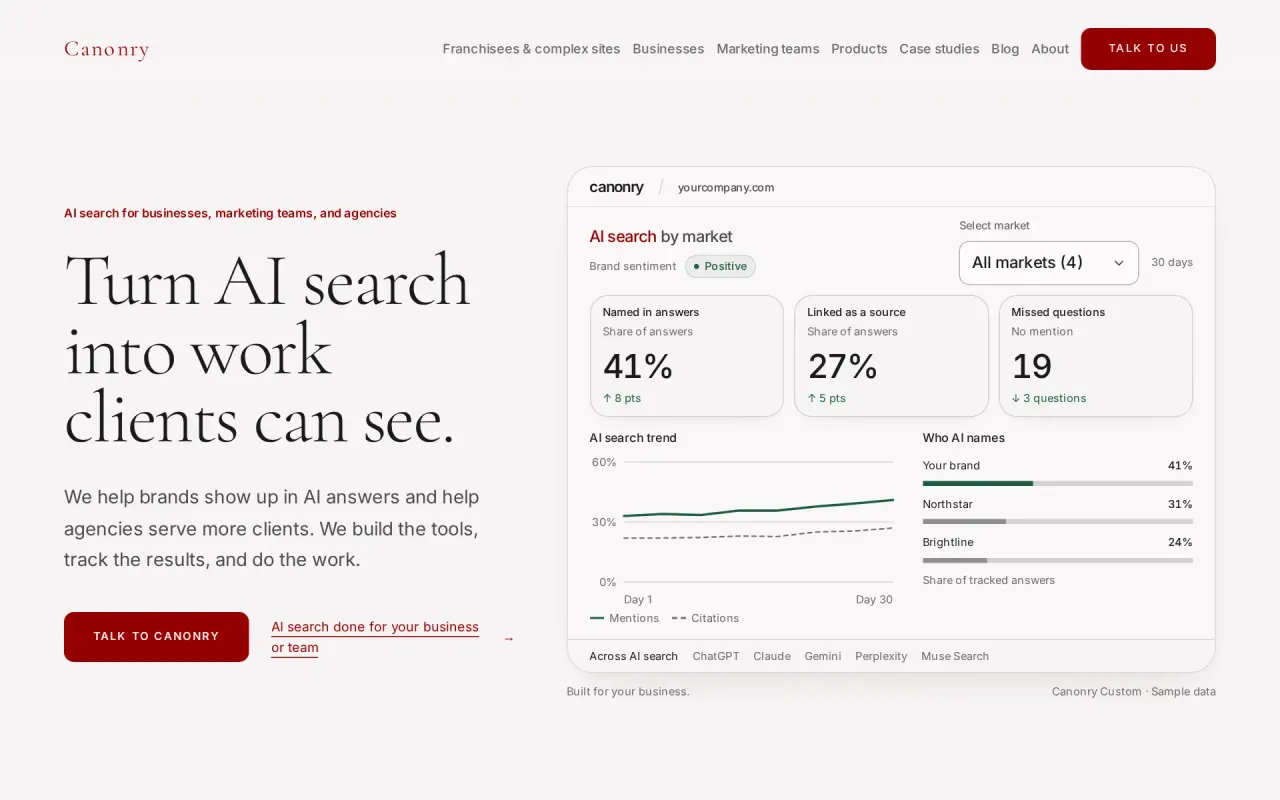
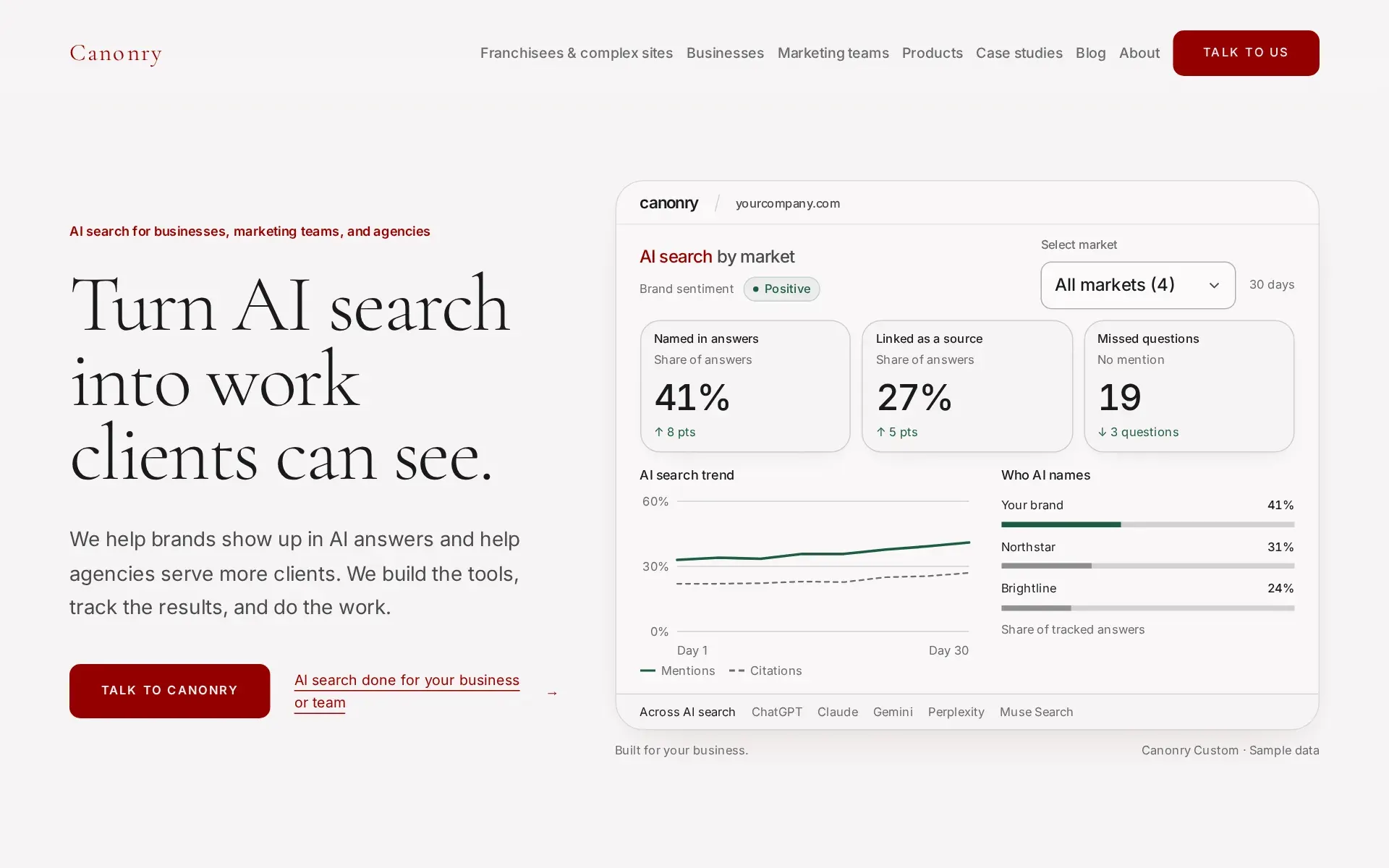
Canonry is an agent-first, open-source Answer Engine Optimization (AEO) platform that tracks how ChatGPT, Gemini, Claude, Perplexity and local LLMs cite a domain, then helps execute the fixes to earn more citations. It is the only tool in this index built to be fully self-hosted: install the CLI, run it on your own machine or server with your own AI-provider keys, and get a dashboard, API and MCP adapter that would otherwise be a paid SaaS subscription. A New York-based company of the same name also sells custom-quoted agency services (white-labeled reporting, managed AEO execution) on top of the same free, source-available engine.
What does Canonry do?
Canonry runs on a local SQLite database and covers the full AEO loop from one CLI/dashboard. It tracks citation and mention rates for tracked queries across Gemini, ChatGPT, Claude, Perplexity and local OpenAI-compatible models on a schedule, with webhook alerts when a domain drops out of an answer. It ingests server logs from Cloud Run, Vercel and a bundled WordPress plugin to see actual AI-crawler visits rather than inferring them, and layers in Google Search Console, Google Analytics 4 and Bing Webmaster data to correlate citations with real traffic. A technical-aeo command crawls a sitemap and scores every page against 16 factors (structured data, E-E-A-T signals, citation and authority signals, content freshness, and more); we ran it live against a 5-page sample of citedindex.com's own sitemap for this listing and it returned an aggregate score of 66/100, correctly flagging our weakest areas as Citations & Authority Signals (24/100) and E-E-A-T Signals (28/100). On the execution side it can push JSON-LD schema and content edits to WordPress directly, and it manages multiple client projects declaratively via config-as-code YAML. A 67-tool MCP adapter and a built-in agent ("Aero") let it run from Claude Code, Codex or any shell-capable coding agent rather than only a human dashboard.
How Canonry works
- Install the CLI and run it self-hosted with your own AI-provider API keys — everything stores locally in SQLite, no vendor account required.
- It tracks citation and mention rates across Gemini, ChatGPT, Claude, Perplexity and local models on a schedule, and ingests server logs (Cloud Run, Vercel, WordPress) plus GSC/GA4/Bing data to correlate citations with real traffic.
- A
technical-aeocommand crawls your sitemap and scores every page against 16 AEO factors — structured data, E-E-A-T, citation and authority signals, freshness. - On the execution side it can push JSON-LD schema and content fixes directly to WordPress, and a 67-tool MCP adapter lets the whole workflow run from Claude Code, Codex, or another agent instead of a human dashboard.
Who is Canonry for?
- Developer-led or privacy-conscious teams that want a free, self-hosted, agent-native AEO stack under their own control rather than a hosted SaaS subscription.
- Teams already working inside Claude Code, Codex, or another shell-capable coding agent that want AEO monitoring and fixes runnable from that same agent.
- Agencies that want white-labeled AI-visibility dashboards embedded in their own client portal (the paid Canonry Embedded/Managed tiers), built on the same free open engine.
Key features
- Multi-engine citation tracking: Scheduled sweeps across Gemini, ChatGPT, Claude, Perplexity and local LLMs, with webhook alerts when a tracked domain drops out of an answer.
- technical-aeo site audit: Crawls a sitemap and scores every page across 16 AEO factors (structured data, E-E-A-T, citations, freshness); we ran it live against citedindex.com for this listing.
- Real traffic correlation: Ingests Cloud Run/Vercel/WordPress server logs plus built-in GSC, GA4 and Bing Webmaster data to check whether AI citations actually drive referral traffic.
- Fix execution: Pushes JSON-LD schema and content changes directly to WordPress and submits URLs for indexing, closing the loop from audit to fix.
- Agent-native control: A 67-tool MCP adapter plus the built-in "Aero" agent let Claude Code, Codex or any shell-capable agent run the whole workflow.
What are Canonry's use cases?
- Free, self-hosted AEO monitoring: A budget- or privacy-conscious team self-hosts Canonry with its own AI-provider keys instead of paying for a hosted visibility SaaS, keeping all citation data in a local SQLite file.
- Agency AI-visibility reporting at scale: An SEO/marketing agency uses the paid Canonry Embedded tier to white-label AI-visibility dashboards inside its own client portal rather than building citation tracking from scratch.
- Proving AI citations drive real traffic: A technical marketer wires up server-log ingestion plus GSC to check whether being cited by an AI engine is actually generating referral visits, not just impressions.
What does Canonry integrate with?
- ChatGPT
- Gemini
- Claude
- Perplexity
- Google Search Console
- Google Analytics 4
- Bing Webmaster Tools
- Google Business Profile
- WordPress
- Common Crawl
Why use Canonry?
- The only self-hosted, open-source option in this index with a full dashboard, CLI and 118+-endpoint API, not just a monitoring script.
- Closes the loop from diagnosis to execution: a technical-aeo audit, JSON-LD/WordPress fixes, and citation re-checks in one product.
- Agent-native by design, a 67-tool MCP adapter and a built-in agent make it usable directly from Claude Code or Codex, not only a human dashboard.
Pros & cons
Pros
- Free and source-available (FSL-1.1-ALv2, converts to Apache 2.0 two years after each release), the fullest-featured self-hosted alternative to this category's paid SaaS dashboards, with a real dashboard, CLI, API and MCP adapter, not just a script.
- Genuinely active: 92 GitHub stars, 12 forks, 690+ commits and a push earlier today, not an abandoned side project.
- Closes the loop other visibility-only tools in this index don't: technical-aeo audit -> JSON-LD/WordPress fix -> citation re-check, in one product.
Cons
- Self-hosting requires your own AI-provider API keys and a Node.js >=22.14 runtime, real setup friction next to a hosted SaaS's zero-install signup.
- FSL-1.1-ALv2 is source-available, not OSI-approved open source: it restricts using Canonry itself to build a competing hosted AEO product until each version's two-year Apache-2.0 conversion date.
- The paid agency layer (Embedded, Ads, Managed) has no published pricing, the same opacity as this category's enterprise incumbents, despite the free self-hosted core.
Limitations
- No first-party hosted dashboard for solo users, the only managed/hosted option (Embedded/Managed) is scoped and custom-quoted for agencies, not individuals.
- A young project (first commit 2026-03-09, about 4 months old at review) with far less track record than the venture-funded incumbents in this index.
Canonry pricing
- Self-hosted (open source)Free
- Canonry EmbeddedCustom / client
- Canonry ManagedCustom
See current pricing on canonry.ai ↗Compare Canonry alternatives →
Canonry specs
Pricing
- Pricing model
- freemium
- Free tier
- ✓ Yes
Canonry review
The self-hosted, agent-native alternative to this category's paid SaaS dashboards, free and source-available, and the only tool here that closes the loop from audit to fix, but budget real setup time (your own API keys, a Node.js runtime) and note the license restricts building a competing hosted product on it for two years per release.
We ran Canonry's own technical-aeo audit live against a 5-page sample of citedindex.com's sitemap for this listing (aggregate score 66/100, strongest on AI-crawler access and schema validity, weakest on Citations & Authority Signals at 24/100 and E-E-A-T Signals at 28/100), confirming the audit works as documented rather than taking the README on faith. Company-background facts are limited to what Canonry states about itself (canonry.ai) plus independently verified GitHub/npm data; the founder's identity (Arber Xhindoli) was cross-checked via his own dev.to post and GitHub profile, not taken from the vendor site alone.
Frequently asked questions
Is Canonry free?
What AI engines does Canonry track?
Does Canonry just monitor, or does it fix things too?
Who builds Canonry?
Canonry alternatives
- Trakkr
Trakkr is a paid, hosted SaaS with GA4 revenue attribution, named-competitor benchmarking and an AI agent that auto-applies weekly actions, if you want a no-install tool over self-hosted software.
Get a quote from Canonry
Tell us what you need. We make the introduction to Canonry.