Stripe
Summary
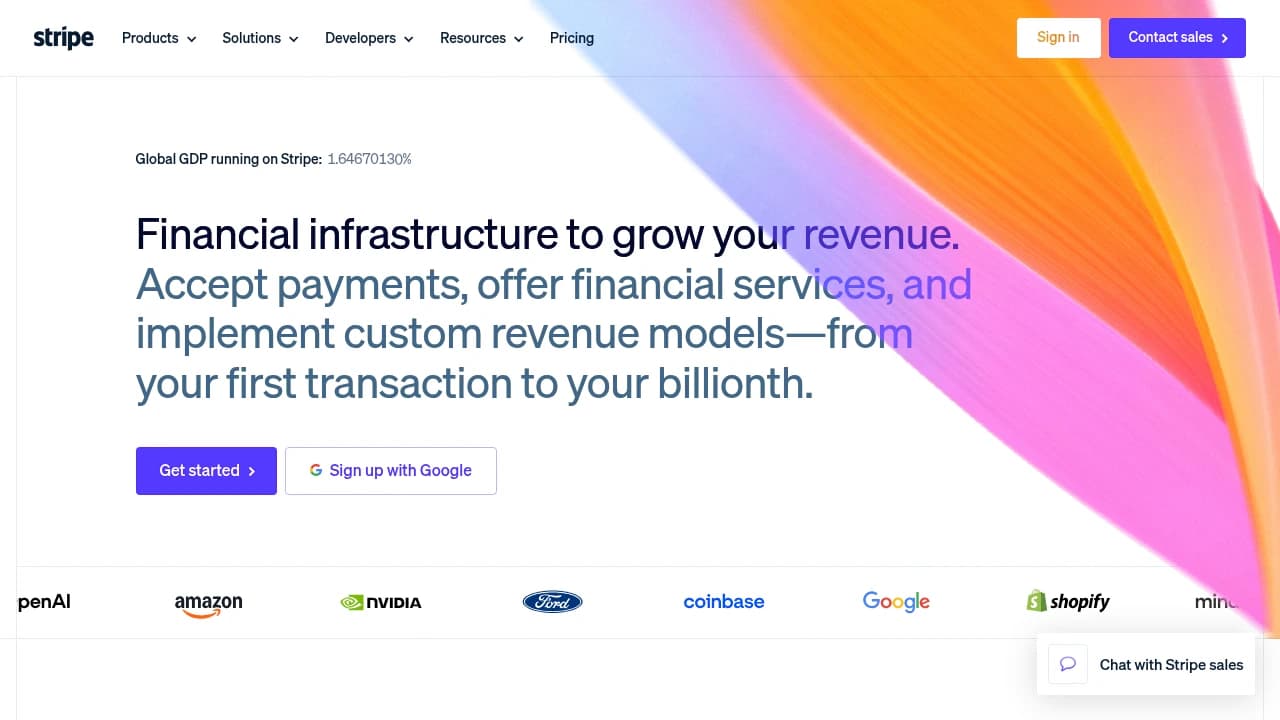
Stripe is a financial infrastructure platform for businesses that need to accept payments, send payouts, and manage revenue operations across online and in-person channels. It combines Payment Processing, Subscription Management, Fraud Prevention, Global Payments, Stripe Connect, Stripe Terminal, Stripe Radar, Stripe Sigma, Invoicing, and Payment links, with APIs, SDKs, and an API reference for custom integrations. Stripe says it supports 195 countries, 135+ currencies, and 100+ payment methods, and customers include Shopify, Lyft, Hertz, Amazon, and BMW. Plans run Starter Free, Standard $20/month, and Enterprise custom.
Verdict. Stripe centralizes payment processing, subscription management, Stripe Connect, and Stripe Terminal in one stack, with pricing that starts at Free and moves to Standard at $20/month before Enterprise custom.
Reviewed byMathijs BronsdijkLast verifiedHow we evaluate
At a glance
- Stripe is best for product teams who need global payments, subscriptions, and payouts in one stack.
- Starter Free; Standard $20/month; Enterprise custom
- Yes — Stripe offers a reliable API for payment processing and custom integrations, with docs and API reference at docs.stripe.com/api.
Highlights
- Covers payments, subscriptions, payouts, and reporting in one platform instead of forcing separate vendors.
- Supports platform and marketplace models through Stripe Connect, including onboarding and third-party payouts.
- Offers both no-code options and APIs, which helps nontechnical teams and developers work from the same system.
- Has broad global reach with 195 countries, 135+ currencies, and 100+ payment methods.
- Backs payment operations with strong reliability claims, including 99.999% historical uptime.
What does Stripe do?
Stripe is a financial infrastructure platform for businesses that need to accept payments, send payouts, and manage revenue operations across online and in-person channels. It serves startups, SaaS companies, marketplaces, and large enterprises that want one system for checkout, billing, and money movement instead of stitching together separate tools. Its product surface includes Payment Processing, Subscription Management, Fraud Prevention, Global Payments, Stripe Connect, Stripe Terminal, Radar, Stripe Sigma, Invoicing, and Payment links. Stripe says it supports 195 countries, 135+ currencies, and 100+ payment methods, and it has 99.999% historical uptime. Customers and users cited by Stripe include Shopify, Lyft, Hertz, and Crypto.com, while the platform also exposes APIs, SDKs, and an API reference for custom integrations.
Who is Stripe for?
- SaaS product teams who need recurring billing, analytics, and payment flows in one platform.
- Marketplace operators who need to onboard sellers and route payouts through Stripe Connect.
- Ecommerce teams who need global checkout, multiple payment methods, and fraud controls.
- Finance and operations teams who need payout management, reporting, and reconciliation.
- Developers who need APIs, SDKs, and custom payment integrations for web or app products.
What are Stripe's key features?
Payment Processing
Accept card and other payment types online or in person, with support for 100+ payment methods and 135+ currencies across 195 countries.
Subscription Management
Bill customers on recurring or usage-based schedules and manage 200M+ active subscriptions on Stripe Billing with reporting and invoicing support.
Fraud Prevention
Use Radar and built-in fraud prevention tools to detect risky transactions, while Stripe says it continuously monitors payments and complies with PCI DSS.
Global Payments
Take payments across borders with multi-currency support, local payment methods, and global payout options for businesses selling internationally.
Developer-friendly API
Build custom payment flows with Stripe APIs, SDKs, and the API reference, backed by docs for payments, Connect, Billing, and payouts.
Stripe Connect
Create platform and marketplace payment flows, onboard users, and manage third-party payouts for 16,000+ platforms actively using Connect.
Stripe Terminal
Accept in-person payments with card-present hardware and unified reporting, so online and offline commerce can live in one system.
Stripe Sigma
Run custom reports on payments and revenue data inside Stripe, helping finance and operations teams analyze performance without exporting everything elsewhere.
How is Stripe used in practice?
Marketplace payouts
Marketplace operators use Stripe to onboard sellers and manage split payments, using Stripe Connect to route funds and handle payout workflows. They can pair it with the Dashboard to monitor balances and transaction activity as the marketplace scales.
Recurring billing for SaaS
SaaS product teams use Stripe to launch subscriptions and track recurring revenue, using Subscription Management to bill customers on a schedule. Stripe Sigma helps them pull custom reports for churn, revenue, and cohort analysis.
Global checkout
Ecommerce teams use Stripe to accept payments across regions, using Global Payment Support to offer local methods and currencies. They can combine it with Optimized Checkout Suite to reduce friction at purchase and improve conversion.
How does Stripe work?
- Open the Dashboard and create your Stripe account, then complete your business profile so Stripe can activate live payments and KYC checks.
- Choose how you want to charge customers, then connect Stripe APIs or no-code tools from the Docs for payments, subscriptions, or donations.
- Set up payment methods and currencies in the Dashboard, including card payments and region-specific options for your target markets.
- Launch your checkout or platform flow, then start accepting payments and routing funds through Stripe Payments or Stripe Connect.
- Use Balances, payouts settings, and Stripe Sigma reports to monitor revenue, schedule payouts, and review performance over time.
How much does Stripe cost?
Starter
Free- Basic payment processing
- Access to Stripe Connect
Standard
$20/month- Features including subscriptions and analytics
Enterprise
Custom- Full suite of features and dedicated support
Frequently asked questions
What does Stripe do?
Stripe is a financial infrastructure platform for businesses that accept payments, send payouts, and manage revenue operations. Its product set spans payments, subscriptions, fraud prevention, reporting, and platform tools like Stripe Connect.
Does Stripe have a free plan?
Yes. Stripe says it offers a free plan that lets you start integrating without initial costs. Its published pricing also includes a Starter tier marked Free, plus Standard at $20/month and Enterprise with custom pricing.
What fees does Stripe charge?
Stripe says it charges a standard fee of 2.9% + 30¢ per successful card charge, with fees varying by payment method and region. It also says there are no setup fees, monthly fees, or hidden fees.
How does Stripe handle security?
Stripe uses advanced fraud detection, complies with PCI DSS standards, and continuously monitors transactions for security. Its Radar product is the named fraud-prevention layer on top of those controls.
Can I integrate Stripe with my app?
Yes. Stripe provides APIs, SDKs, and documentation for custom integrations. The getting-started flow points users to sign up, verify email, complete the business profile, and then follow the Docs to connect Stripe to a website or app.
Does Stripe support marketplaces and platforms?
Yes. Stripe Connect is built for platforms and marketplaces, with onboarding for users and payout management. Stripe says 16,000+ platforms and marketplaces actively use Connect.
What countries and currencies does Stripe support?
Stripe says it supports payments in 195 countries and 135+ currencies, with 100+ payment methods available. That makes it suitable for businesses selling across multiple regions.
How do payouts work in Stripe?
Stripe lets you view balances and manage payouts in the Dashboard. You can set a payout schedule or send manual payouts via the API or Dashboard, and Stripe notes there is a waiting period for the first payout.
Does Stripe have an API?
Yes. Stripe offers a reliable API for payment processing and custom integrations, with docs and API reference at docs.stripe.com/api.

 Your brand here