auto-geo
Free, MIT-licensed CLI that audits, generates, and fixes pages for AI-engine citation, then measures whether it worked.
Best fordeveloper-led teams or solo marketers
Our verdict
The free, open-source alternative to this category's paid dashboards, genuinely useful for a CI-gated citation audit or a solo team's first measurement loop, but it has no UI, no Google AI Overviews coverage, and needs your own API keys, so budget-conscious technical teams are the fit, not marketing teams wanting a dashboard.
We ran auto-geo doctor live against our own flagship comparison page for this listing (score: 3/8, missing a TL;DR block and Article JSON-LD), a genuinely working audit, not vendor copy taken on faith. Company-background facts here are limited to what Shadow states about itself (shadow.inc); an aggregator site's unverified '$10M raised' figure surfaced during research but a funding-tracker cross-check returned an unrelated, unconnected company also named 'Shadow' (Paris-based, founded 2015), so no funding figure is claimed on this listing.
The CitedIndex digest
New tools, fresh verdicts, and who's earning the top spots. One short email.

What's great
- Free and MIT-licensed, no subscription; the only cost is small, pay-as-you-go LLM API usage (roughly $0.06/page for write/fix, per the project's own docs).
- The only tool in this index that does audit + generate + fix + measure in one product, rather than monitoring alone.
- Real, active project: 26 npm releases since June 2026 and roughly 290 downloads/month, built by an operating company (Shadow Inc.) that dogfoods it for its own site.
Watch-outs
- No dashboard or UI at all, pure CLI/JSON output, a real barrier for non-technical marketers used to Otterly- or Profound-style dashboards.
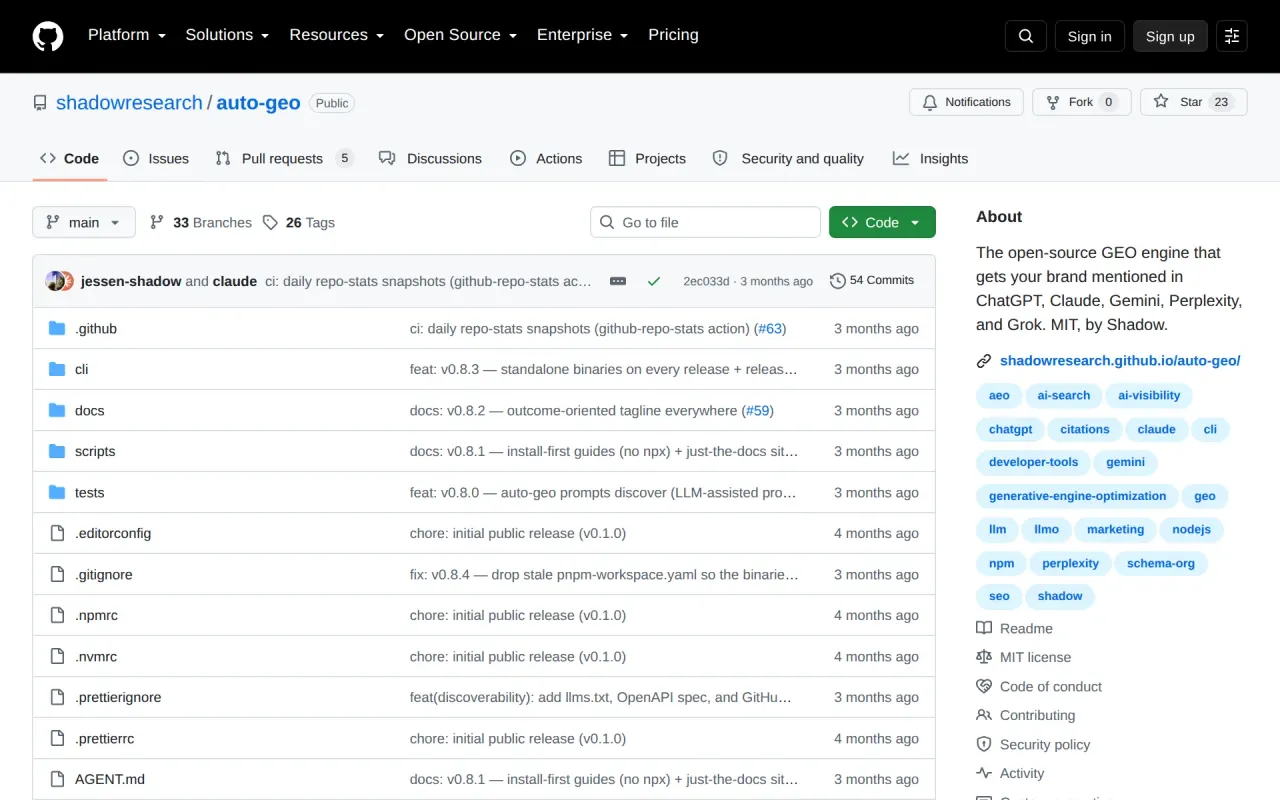
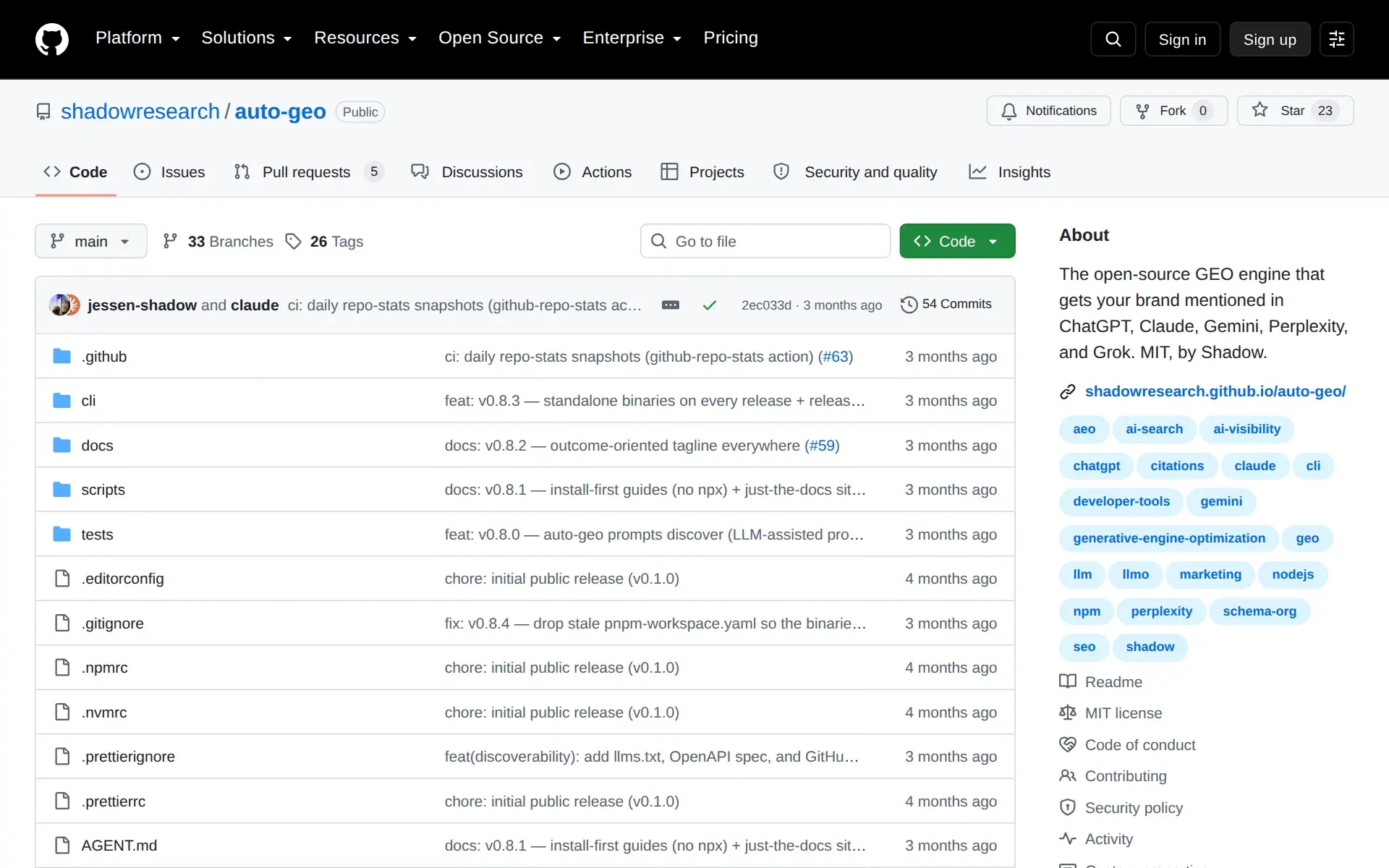
checkmeasures citations by calling provider APIs (OpenAI, Anthropic, Gemini, Perplexity, xAI) directly, not the consumer apps or Google AI Overviews, so despite the "gets you cited in ChatGPT" framing, it does not monitor Google AI Overviews at all, the single engine most other tools in this index lead with.- A young, single-maintainer project (created June 2026, ~17 GitHub stars, no forks yet) with far less track record than the venture-scale incumbents in this index.
Also note: Requires the user's own API key(s) for write/fix/check, OpenAI, Anthropic, Perplexity, Gemini and/or xAI, so real usage carries a small, variable per-run LLM cost on top of the free tool itself. · File-based and local by design: no hosted dashboard, team seats, or multi-user access, built for one developer or one CI pipeline, not a marketing team.
How auto-geo compares
The other tools buyers weigh against auto-geo, and when to pick each.
| Tool | Best when you want… |
|---|---|
| auto-geoThis page | developer-led teams or solo marketers |
| geoSurge | geoSurge's free BYOK tier offers the same bring-your-own-API-key economics but with a hosted dashboard, REST API and MCP access instead of auto-geo's CLI-only, no-UI format -- the tradeoff is geoSurge tracks only 3 engines (ChatGPT, Claude, Gemini) versus auto-geo's 5 (adds Perplexity and Grok). |
| RankScale | RankScale is the cheapest hosted-dashboard alternative ($20/month) once auto-geo's CLI-only, no-account format is a dealbreaker for a non-technical marketing team. |
What is auto-geo?
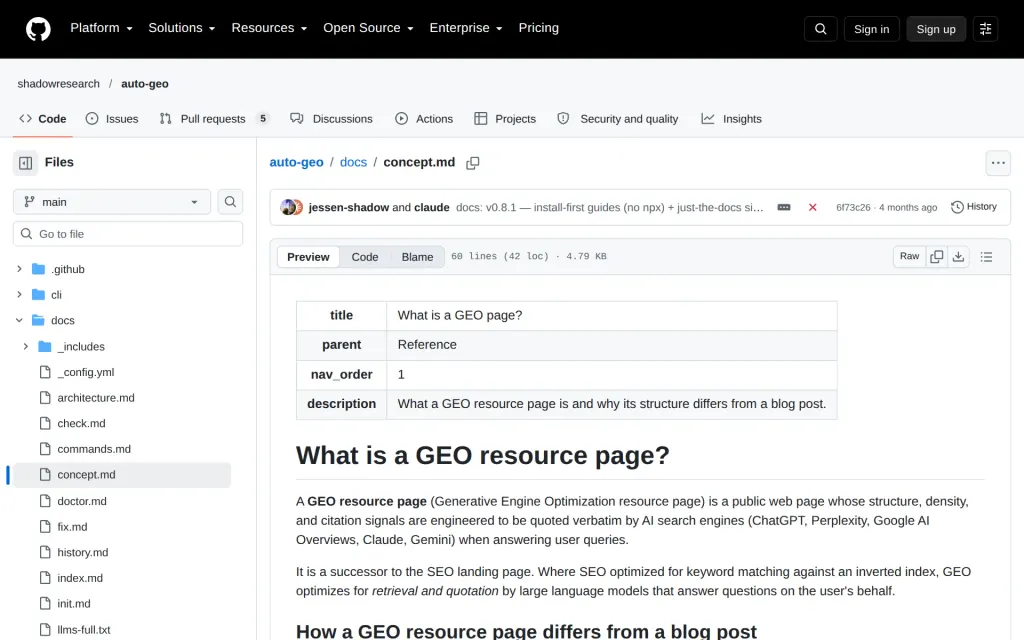
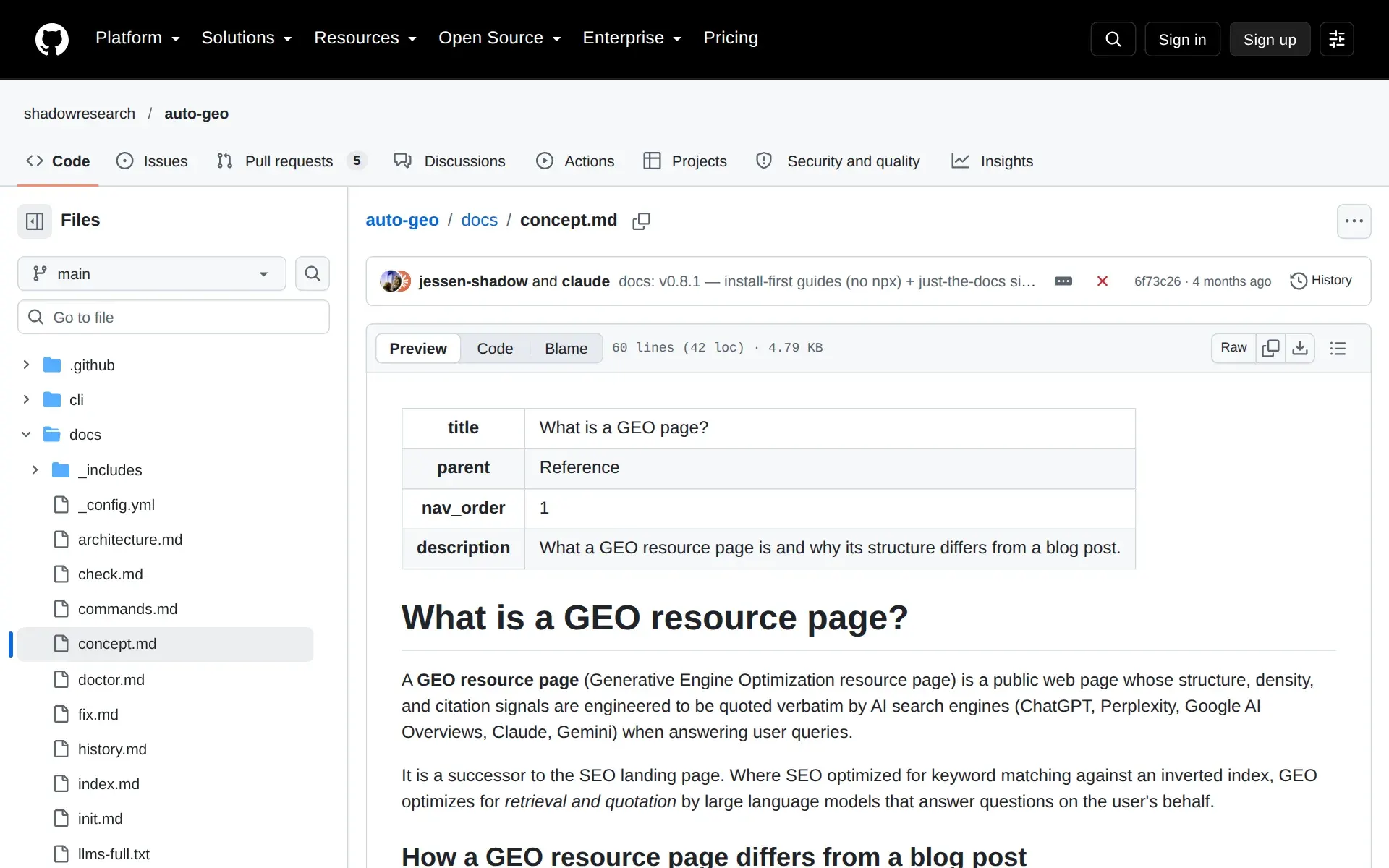
auto-geo is a free, open-source command-line tool for Generative Engine Optimization (GEO): it audits, generates and rewrites web pages so ChatGPT, Claude, Gemini, Perplexity and Grok are more likely to cite them, then measures whether the citations actually happen. Built by Shadow, a media-intelligence company that uses the tool itself to publish shadow.inc's own resource pages, it ships as an MIT-licensed npm package, bring your own OpenAI/Anthropic/Perplexity/Gemini/xAI API key, rather than a hosted dashboard, the opposite pricing and deployment model from every other tool in this index.
What does auto-geo do?
Six subcommands cover the full GEO loop. doctor audits any URL, yours or a competitor's, against eight citation-readiness checks (a TL;DR block, question-format H2s, Article/FAQPage JSON-LD, entity density, image cadence, an answer-first lede, and no self-links) and exits non-zero below a 75% pass rate, so it can gate a CI pipeline. write generates new, schema-validated pages for target queries using GPT-5.4 or Claude Sonnet 4.6 (auto-detected from whichever API key is set), for roughly $0.06 per page per the project's own docs. fix re-audits and rewrites an existing page to pass all eight checks. prompts tracks the exact questions a team wants to be cited for, with an LLM-assisted discover mode that proposes a starting query set from a domain's homepage. check is the outcome measurement: it asks a real AI engine (Perplexity by default, or OpenAI, Anthropic, Gemini, xAI/Grok, or all of them at once) whether the tracked domain is actually cited in the answer, and history turns every saved check into a coverage trend line, which prompts were newly cited, which were lost. We ran doctor against our own flagship comparison page live for this listing and it scored 3/8 (weak GEO posture, missing a TL;DR block and Article JSON-LD), a real, specific, actionable audit, not a generic scorecard.
How auto-geo works
- Run
auto-geo doctoragainst any URL — yours or a competitor's — to score it against eight citation-readiness checks (TL;DR block, question-format H2s, Article/FAQPage JSON-LD, entity density, image cadence, answer-first lede, no self-links). - Use
writeto generate new schema-validated pages for target queries, orfixto re-audit and rewrite an existing page until it passes all eight checks, via GPT-5.4 or Claude Sonnet 4.6. - Track the exact questions you want to be cited for with
prompts, using the LLM-assisteddiscovermode to propose a starting query set from your homepage. - Run
checkto ask a real AI engine (Perplexity, OpenAI, Anthropic, Gemini, xAI/Grok, or all at once) whether the tracked domain is actually cited, then usehistoryto turn every saved check into a coverage trend line.
Who is auto-geo for?
- Developer-led teams or solo marketers comfortable with a CLI who want a free, scriptable GEO audit/fix/measure loop rather than a hosted dashboard.
- Content teams that want a CI-gated citation-readiness check —
doctorexits non-zero below a 75% pass rate — wired into their publish pipeline. - Budget-conscious or privacy-conscious teams that want citation tracking to stay local and git-committable, using their own OpenAI/Anthropic/Perplexity/Gemini/xAI API keys, rather than handing data to a third-party SaaS.
Key features
- doctor, citation-readiness audit: Scores any URL against 8 checks (TL;DR, question-format H2s, Article/FAQPage JSON-LD, entity density, image cadence, answer-first lede, no self-links); exits non-zero below a 75% pass rate so it can gate CI.
- write / fix, schema-validated page generation: Generates or rewrites pages to the same 8-point schema via GPT-5.4 or Claude Sonnet 4.6, for roughly $0.06 per page.
- check, real citation measurement: Queries Perplexity, OpenAI, Anthropic, Gemini or xAI/Grok directly and reports whether a domain is actually cited for a tracked prompt.
- history, coverage trend line: Every check run is saved locally; history reports coverage over time and exactly which prompts were newly cited or lost.
What are auto-geo's use cases?
- Free first GEO audit before buying a monitoring SaaS: A team runs
auto-geo doctor --site sitemap.xmlacross its whole site to find its worst-scoring pages before paying for an enterprise visibility platform. - CI-gated citation readiness: A content team wires
auto-geo doctorinto its publish pipeline so a page can't ship without clearing the 75% citation-readiness bar. - Self-hosted citation tracking with no vendor lock-in: A budget-constrained or privacy-conscious team tracks its own AI-citation coverage over time using its own API keys, with all data staying local and committable to git.
What does auto-geo integrate with?
- OpenAI (GPT models)
- Anthropic (Claude)
- Google Gemini
- Perplexity
- xAI (Grok)
Why use auto-geo?
- The only tool in this index that closes the full loop, audit, generate, fix AND measure citations, in one product; most competitors do either monitoring or content optimization, not both.
- Free and MIT-licensed; the only ongoing cost is small, pay-as-you-go LLM API usage, not a monthly seat.
- File-based and git-committable by design, no account, no server, no third party holding your citation data.
Pros & cons
Pros
- Free and MIT-licensed, no subscription; the only cost is small, pay-as-you-go LLM API usage (roughly $0.06/page for write/fix, per the project's own docs).
- The only tool in this index that does audit + generate + fix + measure in one product, rather than monitoring alone.
- Real, active project: 26 npm releases since June 2026 and roughly 290 downloads/month, built by an operating company (Shadow Inc.) that dogfoods it for its own site.
Cons
- No dashboard or UI at all, pure CLI/JSON output, a real barrier for non-technical marketers used to Otterly- or Profound-style dashboards.
checkmeasures citations by calling provider APIs (OpenAI, Anthropic, Gemini, Perplexity, xAI) directly, not the consumer apps or Google AI Overviews, so despite the "gets you cited in ChatGPT" framing, it does not monitor Google AI Overviews at all, the single engine most other tools in this index lead with.- A young, single-maintainer project (created June 2026, ~17 GitHub stars, no forks yet) with far less track record than the venture-scale incumbents in this index.
Limitations
- Requires the user's own API key(s) for write/fix/check, OpenAI, Anthropic, Perplexity, Gemini and/or xAI, so real usage carries a small, variable per-run LLM cost on top of the free tool itself.
- File-based and local by design: no hosted dashboard, team seats, or multi-user access, built for one developer or one CI pipeline, not a marketing team.
auto-geo specs
Pricing
- Pricing model
- free
- Free tier
- ✓ Yes
auto-geo review
The free, open-source alternative to this category's paid dashboards, genuinely useful for a CI-gated citation audit or a solo team's first measurement loop, but it has no UI, no Google AI Overviews coverage, and needs your own API keys, so budget-conscious technical teams are the fit, not marketing teams wanting a dashboard.
We ran
auto-geo doctorlive against our own flagship comparison page for this listing (score: 3/8, missing a TL;DR block and Article JSON-LD), a genuinely working audit, not vendor copy taken on faith. Company-background facts here are limited to what Shadow states about itself (shadow.inc); an aggregator site's unverified '$10M raised' figure surfaced during research but a funding-tracker cross-check returned an unrelated, unconnected company also named 'Shadow' (Paris-based, founded 2015), so no funding figure is claimed on this listing.
Frequently asked questions
Is auto-geo free?
Does auto-geo monitor Google AI Overviews?
check measures citations by calling the OpenAI, Anthropic, Gemini, Perplexity and xAI APIs directly, not Google AI Overviews or the consumer chat apps, so it cannot confirm what actually renders inside Google's AI Overview panel.What does the `doctor` command check?
Who builds auto-geo?
auto-geo alternatives
- geoSurge
geoSurge's free BYOK tier offers the same bring-your-own-API-key economics but with a hosted dashboard, REST API and MCP access instead of auto-geo's CLI-only, no-UI format -- the tradeoff is geoSurge tracks only 3 engines (ChatGPT, Claude, Gemini) versus auto-geo's 5 (adds Perplexity and Grok).
- RankScale
RankScale is the cheapest hosted-dashboard alternative ($20/month) once auto-geo's CLI-only, no-account format is a dealbreaker for a non-technical marketing team.
Get a quote from auto-geo
Tell us what you need. We make the introduction to auto-geo.